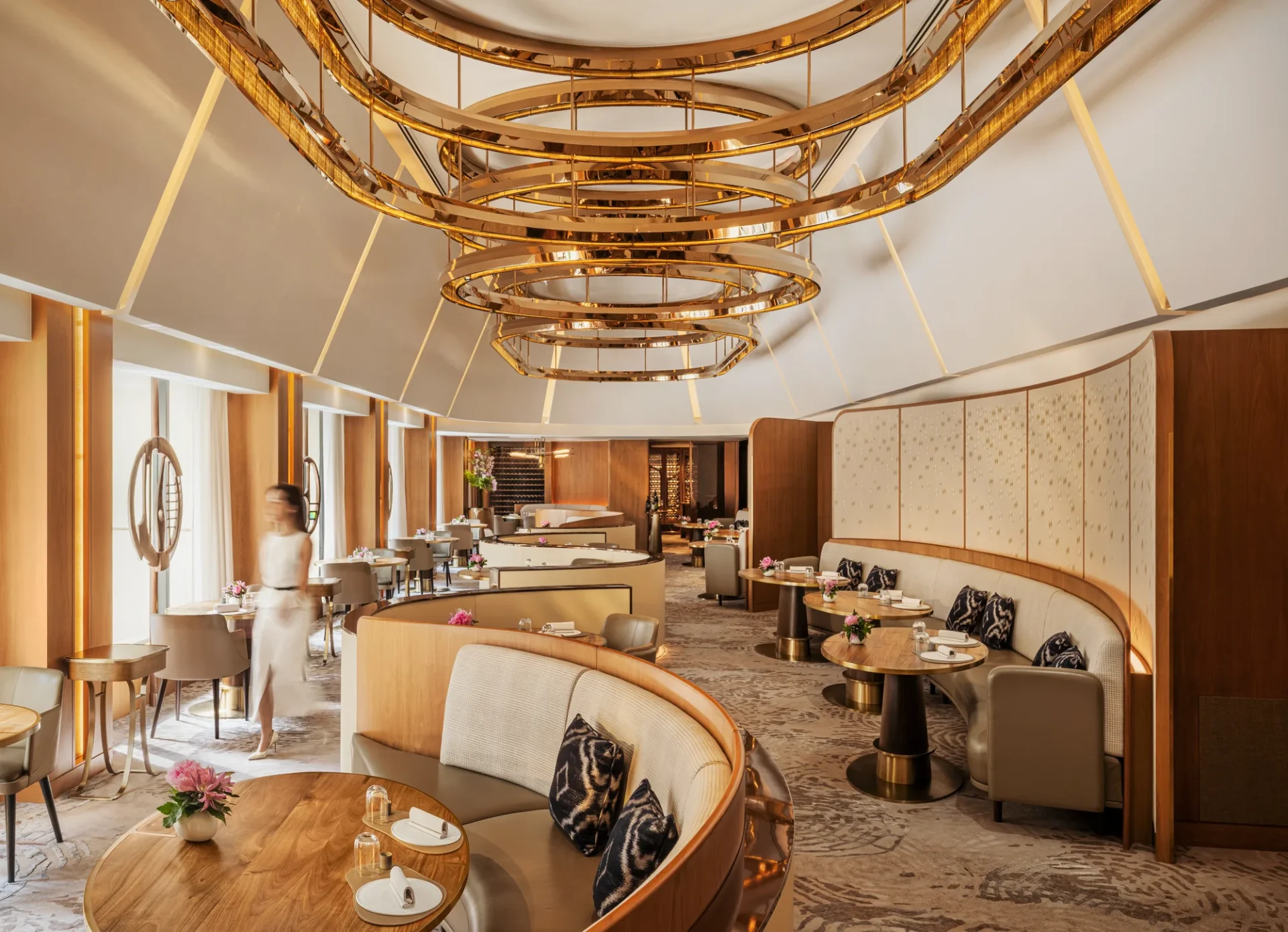
Amber dining room. Chef Richard Ekkebus. Courtesy of Amber / The Forks & Spoons. Photo source
Amber’s dinner on 27 October 2026 places an eight-glass alcohol-free pairing by Dutch beverage specialist Bram Klinge alongside the cooking of Richard Ekkebus, Agustin Balbi, Antimo Maria Merone, Paulo Airaudo and Luigi Troiano. With contributions from Amber, Andō, Estro and NOI, the evening offers a useful lens on pairing as menu composition: drinks must respond to individual dishes while sustaining a coherent progression. Klinge’s announced approach uses culinary techniques, including fermentation and extraction, to work with flavour, aroma and texture. For beverage teams, the interest lies in treating the pairing as a programme with its own authorship. This is a preview of the announced dinner; the alcohol-free description applies to the drinks, while some food components contain alcoholic ingredients.
Highlights
- Amber hosts the collaboration in Hong Kong on 27 October 2026, with an eight-glass alcohol-free pairing included.
- Bram Klinge’s beverage programme will connect dishes from Amber, Andō, Estro and NOI.
- The menu gives the pairing different tasks, from seafood and cheese-filled pasta to pigeon and chocolate.
- Guests avoiding alcohol in all forms should discuss the food as well as the drinks with the restaurant.
The glass has a point of view
A collaboration dinner brings a particular kind of abundance to the table. Each kitchen arrives with a language of its own, and each dish has to say enough about that kitchen to justify its place. The beverage programme faces a quieter challenge: to accompany those different voices without making the evening feel like several menus stitched together.
At Amber this October, that task belongs to Bram Klinge. The Dutch bartender and non-alcoholic beverage specialist will devise eight glasses for a dinner involving Richard Ekkebus’s Amber, Agustin Balbi’s Andō, Antimo Maria Merone’s Estro and NOI, represented by Paulo Airaudo and Luigi Troiano. The collaboration has been announced for 27 October at Mandarin Oriental The Landmark, Hong Kong.
There is a compelling editorial idea here. A single beverage author can give a multi-chef menu continuity. The pairing becomes a way of reading the progression, picking up one quality in a dish and preparing the palate for the next. Its success will depend on those relationships, rather than on the number of techniques behind each glass.
Four kitchens, different demands
The announced food makes that responsibility tangible. NOI’s tuna belly brings uni, caviar and dashi jelly into the same course. A pairing has to consider the concentration of marine flavours as well as the fat of the fish. Simply reaching for sweetness would address very little of what that composition asks of a drink.
Estro’s bottoni, filled with buffalo robiola and accompanied by turnip tops and bottarga, pose another question. Cheese, greens and cured roe give the beverage team several possible points of contact. The useful decision is which one to foreground, and which to leave to the dish. A glass that repeats every ingredient would have little space to contribute an idea of its own.
Andō’s caldoso rice with squid brings the menu into a different register again, while Amber’s kinmedai sits within a velouté of sake and Koshihikari rice. These are distinct expressions of rice and seafood, rather than interchangeable courses. Reading their differences is precisely the work of pairing. The drink should help the guest perceive the dish more clearly.
Later, Estro’s pigeon introduces burned leek, liver mousse and pepper berry jus. The movement towards darker, more concentrated cooking gives Klinge another set of choices about intensity and sequence. We do not yet know the individual drinks. The published menu nevertheless makes clear why this evening needs a composed beverage programme.

Bottoni at Estro. Chef Antimo Maria Merone. Photo: Nicholas Wong, Sixteen Photography. Photo source

Bram Klinge. Courtesy of Amber / The Forks & Spoons. Photo: Àlex Froloff. Photo source
Technique in the service of the menu
Klinge’s stated approach draws on fermentation, clarification, distillation, extraction and dehydration. He describes building through sweetness, acidity, salinity, umami and bitterness, alongside aroma and texture. That vocabulary places his work close to the kitchen: a drink can be developed around a culinary purpose, then adjusted through trials with the dish.
For a restaurant team, the practical distinction is significant. Choosing an ingredient because it sounds interesting is an early step; deciding its concentration, temperature, portion and position within a sequence is where a programme takes shape. Eight glasses require a sense of proportion across the whole evening. The last pour has to make sense in relation to the first.
The event also puts the alcohol-free experience at the centre of its hospitality. The eight-glass pairing is included in the dinner price, and outside wines and other alcoholic beverages are not permitted. Guests will share the same basic beverage proposition. That gives the room an opportunity to explain these drinks with the confidence and attention normally afforded a wine pairing.
Precision includes the guest conversation
One detail deserves clear language. The food menu names sake in Amber’s fish course, Shaoxing wine in the dessert’s macerated raisins, and a whisky gum among the petits fours. An alcohol-free beverage pairing does not establish that every dish is free of alcoholic ingredients. The announcement does not specify residual alcohol levels or suitable substitutions.
Anyone avoiding alcohol throughout a meal should therefore discuss the menu directly with the restaurant. For service teams, this is part of understanding the guest’s request. The distinction between declining a glass of wine and avoiding alcohol in food can affect kitchen preparation as well as the pour.
Amber’s evening is worth following because it gives beverage authorship a clear role within a serious culinary collaboration. After the dinner, the most useful question will be how Klinge’s glasses connected the chefs’ ideas: where they clarified a flavour, changed the pace or gave a familiar dish a different frame. That is the detail that can travel beyond a single service and inform another restaurant’s programme.
The evening
The dinner takes place on Tuesday, 27 October 2026 at Amber, Mandarin Oriental The Landmark, Hong Kong. The announced price is HK$3,788 per person, plus 10% service charge, including Klinge’s eight-glass pairing and Nordaq still and sparkling water. Reservations are through Amber’s official booking link. The menu remains subject to seasonal changes.