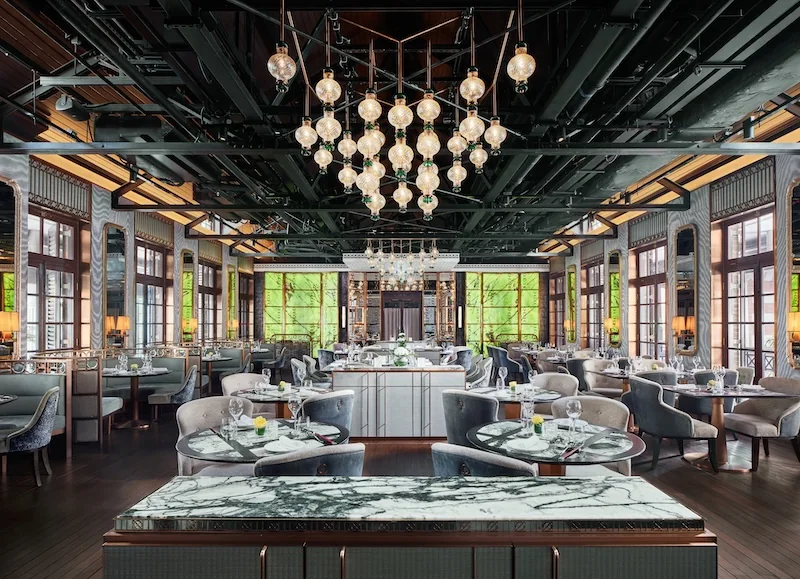
The Chinese Library, Tai Kwun. Chef Junno Li. Courtesy of The Chinese Library / The Forks & Spoons. Photo: Owen Raggett. Photo source
The Chinese Library in Hong Kong will serve its limited-time hairy-crab menu from 19 October to 30 November 2026, subject to availability. Executive Chef Junno Li presents six à la carte dishes, moving from roe-filled dim sum to braises and whole steamed crab. Read together, the preparations offer a study in texture: broth carries the ingredient into a dumpling, tofu and fish maw give it different settings, and crisp rice vermicelli lets the guest influence the final mouthful. For chefs, the menu suggests how a focused seasonal addition can create variety without losing its central idea. This preview draws on the restaurant’s current menu and supplied preparation notes; it does not claim a tasting or visit.
Highlights
- The hairy-crab menu runs from 19 October to 30 November 2026, while stocks last.
- Junno Li uses six à la carte preparations to explore roe, meat, broth and texture.
- Crab roe with crisp rice vermicelli introduces an element of table-side participation.
- The current restaurant menu lists whole male crab at 190g and female crab at 170g.
A season given several forms
A seasonal ingredient can appear throughout a menu without telling the same story twice. What changes is the setting: how it meets the tongue, what carries its flavour, how much work the kitchen has done and how much remains for the diner. That is the promise of Junno Li’s forthcoming hairy-crab menu at The Chinese Library.
At the Tai Kwun restaurant, the executive chef has built six à la carte preparations around the crab’s meat and roe. The menu opens on 19 October and continues until 30 November, while stocks last. Its interest lies in the movement between forms: the enclosed richness of a dumpling, the more open expression of a braise, and the patient encounter with a whole crab.
Li’s approach gives the ingredient a recognisable centre while changing the way the guest reaches it. A seasonal menu needs that distinction. Repetition of the principal ingredient can establish identity; repetition of the eating experience can make the meal feel narrow. Here, the announced preparations provide several ways into the same autumn offering.
The broth inside the wrapper
The xiao long bao begin before a wrapper is filled. According to the kitchen’s supplied preparation notes, a stock made with crab meat is set into jelly, then incorporated into a filling with pork, roe, crab oil and aromatics. The broth becomes part of the dumpling’s construction. This is a way of carrying the ingredient into the centre of the mouthful, rather than placing a seasonal garnish on a familiar dish.
That detail is worth pausing over. A menu description can make crab roe sound like a single addition. The preparation reveals a more distributed role: meat in the stock, roe in the filling and oil contributing another expression of the ingredient. Ginger, garlic and salted egg yolk are also named in the notes. We can read the intended layering without pretending to know the finished balance.
The pan-fried dumplings change the structure. They are steamed before being pan-fried, with pork and pea shoots among the filling ingredients. Beside the xiao long bao, they offer a different relationship between wrapper and interior. The decision to include both makes sense when their textures are allowed to distinguish them.
The supporting ingredient matters
The braises shift attention from the wrapper to the ingredient receiving the sauce. Fish maw appears with crab roe in chicken broth, while another preparation brings tofu and fish maw together. The cooking asks us to consider the supporting ingredients as part of the idea, rather than as neutral backgrounds.
Tofu offers a different structure from fish maw. Placing both within the seasonal selection lets the kitchen explore how the same crab element reads against distinct textures. The preparation notes for the tofu dish describe crab oil used with the aromatics and sweet peas added at the finish. Those choices give the dish more structure than its short menu title can communicate.
For a chef planning a focused seasonal offering, this is a useful example of variety built through preparation. A principal ingredient does not need six elaborate reinventions to earn six appearances. Changing the broth, carrier and degree of enclosure can give each dish a purpose, provided the distinctions are apparent to the guest.
The à la carte format supports that approach. Guests can choose a small encounter with the season or assemble several dishes. It also means the service team has a role in helping a table find variety. Explaining the difference between the two dumplings, or between the braises, is more useful than presenting each as another expression of richness.

Hairy-crab tofu preparation. Chef Junno Li, The Chinese Library. Courtesy of The Chinese Library / The Forks & Spoons. Photo source

Steamed hairy crab. Chef Junno Li, The Chinese Library. Courtesy of The Chinese Library / The Forks & Spoons. Photo source
A little control at the table
The crab-roe preparation with crisp rice vermicelli has the most explicit element of participation. The kitchen’s notes describe pan-fried noodles served with a separate braise incorporating fish maw and broth. Combining them changes the texture as the liquid reaches the crisp strands.
That makes the guest’s timing part of the dish. Adding the braise gradually can leave a different balance of soaked and crisp noodles from combining everything at once. This is an interpretation of the announced service format, rather than a report of the finished dish. It nevertheless points to a clear opportunity for the dining room: a brief explanation can help a guest understand what they are being invited to do.
Whole steamed hairy crab, served with ginger tea, brings the selection back to the ingredient in its most direct form. Alongside dishes in which the kitchen has extracted and enclosed the crab, the whole specimen preserves the encounter with shell and meat. It changes the pace of eating and completes the range of preparations without requiring another layer of invention.
What a focused menu can teach
The Chinese Library’s seasonal selection is worth watching for its composition. Its strongest idea is the range of encounters it proposes with one ingredient. The chef supplies the transformations; the dining room can make their differences legible. That relationship matters when a menu is concise enough for guests to compare its dishes.
The lesson for another kitchen is a practical one: decide what each preparation contributes before adding another seasonal item. A dumpling, a braise and a whole crab can belong together when they offer distinct experiences. The ingredient provides continuity, while texture and service give the guest a reason to explore.
The seasonal window
The menu is available at The Chinese Library, Tai Kwun, Hong Kong, from 19 October to 30 November 2026, while stocks last. The current menu lists xiao long bao at HK$168 for three, pan-fried dumplings at HK$188 for four, and the braises from HK$288 to HK$398. Whole male crab is listed at 190g and HK$388; female crab at 170g and HK$378. All prices are subject to 10% service charge. Consult the restaurant’s current menu for availability.