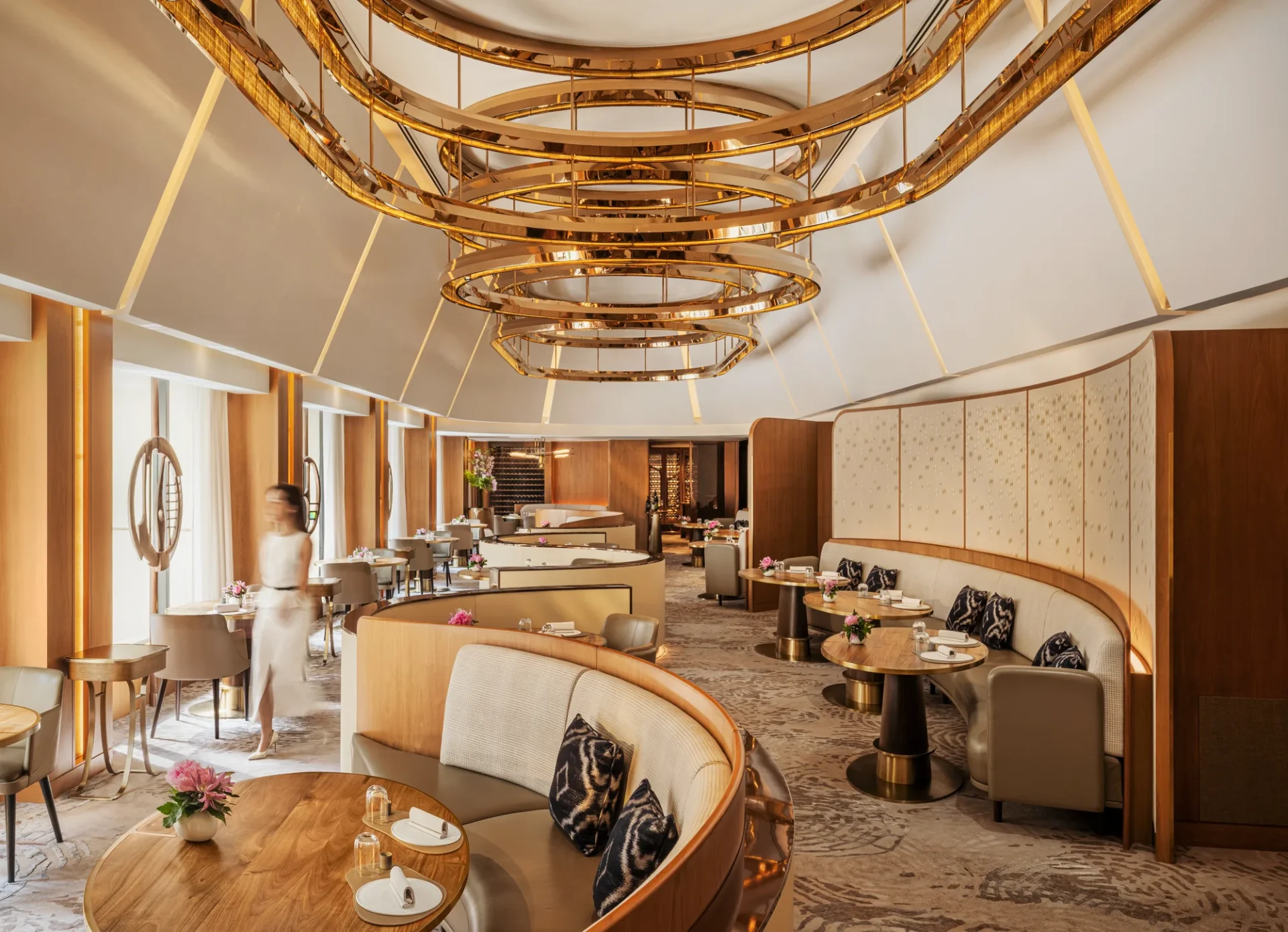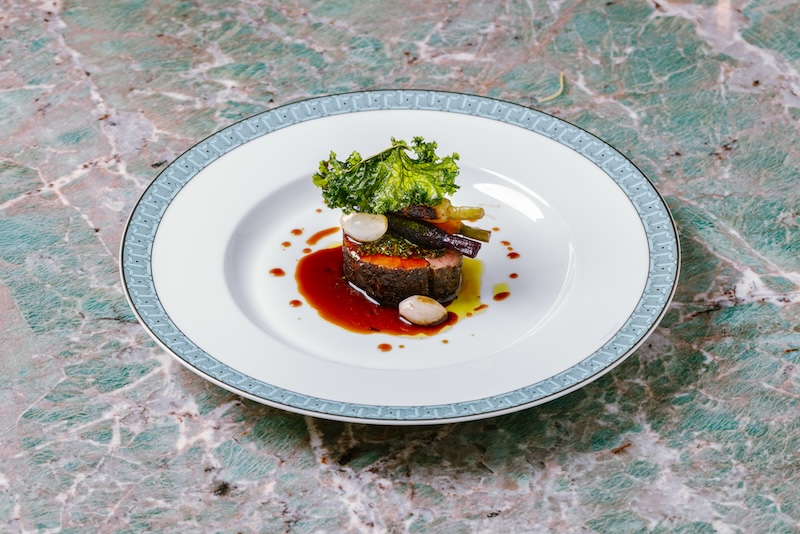

Fallow, St James’s, London. Photo: Rccn, Wikimedia Commons, CC BY 4.0
In 2024, with Fallow full most nights in St James’s, James Robson was asked the question every successful restaurateur hears sooner or later. Was there pressure to grow? “No,” he told the food writer Andy Lynes. The business had no shareholders and no private equity, and no one was waiting for a return. He was candid about the conditions (“it’s never been harder”) and just as clear about the map. “I’ll be honest, I’ve not got a lot of appetite to go outside London,” he said. New York was “a pipe dream at the moment.”
Two years later Fallow’s owners have Roe in Canary Wharf, the Fowl chicken shops and, since August, the OXO Tower Restaurant on the South Bank. They grew, but on their own clock, in their own city, and in each case into a site that suited a particular idea. That is the most useful thing about Fallow’s story: the second address was a decision, not a reward.

Hawksmoor Wood Wharf, London. Photo: The wub, Wikimedia Commons, CC BY-SA 4.0. London first, then New York and Chicago.
Why expand at all?
Recognition creates its own momentum. A star, a list placing or a viral dish brings landlords, hotel groups and investors to the door, and each offer arrives as a compliment. The honest reasons to say yes are fewer. There is demand the first room cannot serve. There is a team whose best people need somewhere to grow, or they will leave. There is an opportunity that genuinely improves the business, rather than one that simply enlarges it.
The dishonest reason is harder to spot because it sounds like ambition. It is the feeling that success must be turned into growth before it fades. Robson drew the line clearly: groups backed by private equity “have to expand.” Fallow did not.
What actually travels
Most expansion plans assume that what made the first restaurant succeed can be packed and shipped. Much of it can’t.
When Hawksmoor took its steakhouse to New York and Chicago, the recipe was the easy part. The beef was not. The group buys locally for every restaurant, so the British grass-fed supply chain behind the London menu could not cross the Atlantic, and its US kitchens had to find farmers working “the way we think it should be done”, in Will Beckett’s words. What travelled was a standard, not a product.
Hong Kong’s Mott 32 learned the same lesson heading the other way. Since opening in 2014 it has travelled to Vancouver, Las Vegas, Bangkok, Singapore, Seoul, Cebu, Dubai and Toronto, and its co-founder Malcolm Wood is clear that what makes the journey is people, not recipes. Several of the chefs and front-of-house staff who opened the original in Hong Kong now lead kitchens and dining rooms in those cities.
“Hong Kong has always been our training ground,” Wood told Chefs MAG. “Some of the people who were with us on day one are now running our teams abroad, and they carry the standards with them, from how a duck is roasted to how a guest is greeted. You can write all of that down, but it travels best in people.”
The group’s culinary directors still move between markets, cooking alongside local teams and checking each venue against the Hong Kong benchmark. “Consistency isn’t something you set at opening and walk away from,” he says.

Celebration Peking Duck, Mott 32 Hong Kong. Photography courtesy of Mott 32

Mott 32 Hong Kong. Photography courtesy of Mott 32

Mott 32 Las Vegas. Photography courtesy of Mott 32

Mott 32 Vancouver, the Bird Cage dining room. Photography courtesy of Mott 32
Clare Smyth made the same point from the other side of the world. Oncore, at Crown Sydney, was “very much the sister restaurant to Core,” she told Forbes Australia in 2025, yet it cooked only with Australian produce, and she refused to substitute New Zealand fish. Her plan was to visit about four times a year. What she exported was a way of working, and a team trained in it: the people running the room in Sydney had eaten at Core in London. It did not last. Oncore served its final guests on 28 February 2026, after four years, and neither Smyth nor Crown gave a reason.
Who protects the original?
This is the question owners skip. If the chef who defines the first restaurant moves to open the second, someone has to hold the standard that earned the opportunity in the first place. Smyth’s answer was to stay in London and build the new kitchen around people steeped in hers. Robson’s was to surround two young chefs at “the top of their game” with as much industry experience as he could find.
Where there is no such person, the second address is paid for by the first.

The brigade that holds the standard. Photo: JC Gellidon
Which model fits?
“Opening abroad” covers very different deals, and the income, control and risk change with each.
- Owning the second restaurant keeps control and keeps the risk.
- A hotel or resort partnership brings a site, capital and a guaranteed flow of guests, but the landlord’s priorities sit at the table. Oncore opened, and closed, inside Crown Sydney. New York’s Carbone, opened in 2012, reached Dubai in October 2025 inside Atlantis The Royal, and its owners, Major Food Group, have grown abroad by partnering with hotels and brands.
- A joint venture or majority investor brings local knowledge and money. Pizza Pilgrims is entering Germany with L’Osteria, its majority owner, which supplies relationships, property knowledge and infrastructure.
- A franchise can spread a name quickly. In the UAE, Wagamama and Rosa’s Thai trade through local operators.
- A consultancy lends the chef’s name, while someone else runs the kitchen and its standards.
Whatever the structure, the partner matters as much as the paperwork. “We’ve always been prepared to wait for the right partner and the right location rather than force the concept into a city,” says Mott 32’s Malcolm Wood. “Every partner we choose has to share our obsession with quality, because they become custodians of the brand.”
None of these is wrong. Each is a different business from the one that won the praise.

Carbone, Thompson Street, New York. Photo: MainlyTwelve, Wikimedia Commons, CC BY-SA 4.0. Since October 2025, also in Dubai.
Why that market?
Restaurants now cross borders in every direction. Carbone went from New York to Dubai. Mott 32 went from Hong Kong to North America, Asia and the Gulf. In November 2025 GOAT, a burger brand founded in Dubai in 2021, made its international debut in London’s Knightsbridge. Its co-founder Sultan Kayed chose the city, he said, because it “celebrates diversity and creativity in the same way we do”. Each move came with a reason tied to the new market: a hotel partner for Carbone, partners Mott 32 was prepared to wait for, and, for GOAT, a city its founders felt matched their brand.
Here the story becomes sharper, and London shows why. British operators are heading abroad in numbers. JKS is taking Gymkhana to Dubai, beside its Berenjak, and entering the US. Dishoom took outside investment for the first time and has committed to a New York site for 2027, and Hawksmoor keeps adding American restaurants. The consultancy Juniper calls the UK a “beleaguered home market”, and the costs are real. Since April 2025 employers’ National Insurance has risen from 13.8% to 15% on a lower threshold, and hospitality’s business-rates relief has fallen from 75% to 40%.
But a restaurant can be ready to expand at the same moment its home market stops being where its owners want to invest. Those are two different conclusions, and they should not be confused. The first is about the restaurant. The second is about tax, rent and confidence. An overseas opening explained only by the second is not an expansion. It is relocation by instalments, and it should be judged as one.
Nor does a generous offer make a business. Local demand, partners, staff, property terms and supply chains decide whether a site survives once the opening incentives run out. The US, Juniper notes, is “high-risk, high-reward”, and Pizza Express and Carluccio’s both learned that the hard way and left.
When the answer should be no
The clearest case for staying put came from Gabrielle Hamilton, asked in 2015 why she had never multiplied Prune. The restaurant, she said, “couldn’t be replicated”. It was “a feeling”, and she could not give several more restaurants what she gave that one. As Andrew Zimmern put it, her refusals kept Prune from becoming “50 Prunes in Westin hotels”.
The answer should also be no when expansion depends on stretching a team that is already thin: when the sous chef who would run the new kitchen is the only person holding the old one together, or when the plan quietly assumes nobody will leave.

One room, one table, one standard. Photo: Hitesh Dewasi
Our take
A second address tests one thing: whether a restaurant’s success belongs to a system that can be taught, or to a particular chef, team and place. Fallow’s owners have kept asking that question before signing. The restaurants that last tend to be the ones whose owners answer it honestly, including when the answer is one restaurant, done well.
Have your say
Have you opened a second address, or decided not to?
We are collecting stories from chefs, restaurateurs and hoteliers about expansion: what worked, what didn’t, and what you would do differently. The best will feature in a follow-up in The Brief.
Share your storyor write to hello@chefsmag.com
Sources
Andy Lynes, Smashed: An interview with restaurateur James Robson, the man behind Fallow, Roe and Fowl, 10 September 2024
Restaurant Online: Fallow and Roe team acquire OXO Tower Restaurant, 13 August 2026
City A.M.: Hawksmoor’s Will Beckett is ready to take on the American steakhouses, 10 September 2024
Forbes Australia: How Australia won the heart of a 3 hat, 3 Michelin Star British chef, 18 February 2025
Juniper: Three very different bets: why UK restaurant brands are heading to Germany, Dubai and the US, 11 September 2026
Caterer & Licensee: Hospitality business rate relief extended but NI contributions rise, 30 October 2024
Fortune: Gabrielle Hamilton on saying no, 24 June 2015
Wikipedia: Mott 32 (locations and years)
Caterer Middle East: CARBONE Dubai opens at Atlantis The Royal, 7 October 2025
Wikipedia: Major Food Group
The Caterer: Dubai’s GOAT burger lands in London, 18 November 2025
Restaurant Online: Clare Smyth’s Sydney restaurant Oncore to close its doors next year, 12 November 2025
Mott 32: statement from co-founder Malcolm Wood to Chefs MAG, October 2026
Photography: Mott 32 images courtesy of Mott 32. Fallow, Hawksmoor and Carbone images from Wikimedia Commons, credited with their licences. Other images from Unsplash; these are illustrative and do not show the restaurants named in this article.