Restaurant technology is only useful when it solves a clearly defined operational problem without creating a new one for the guest. McDonald’s ArchIQ voice-ordering trial completed 90% of drive-thru orders without human escalation across roughly one million transactions — a figure that reads as a triumph in a software report and as a serviceable-but-fragile result on a busy lane at 1:00 PM. The real lesson of 2026’s voice-AI rollouts is that automation does not remove labour from the order-taking process; it reallocates it to the far more stressful job of correcting the machine’s mistakes. Behind the front-of-house controversy, though, back-of-house AI — demand forecasting and waste intelligence — is quietly doing exactly what was promised.
Highlights
- McDonald’s ArchIQ voice AI completed 90% of tested drive-thru orders without escalating to a human.
- “Completed without escalation” is not the same as “correct” — a ticket can pass the speaker box and still reach the kitchen wrong.
- When voice AI fails, the cognitive load shifts to whoever has to untangle the order and calm the guest — not away from staff, onto them.
- Back-of-house AI (demand forecasting, waste intelligence) is where the technology is already delivering measurable margin protection.
- The industry’s labour-cost pressure (+35% since 2019) is the real force pushing operators toward automation, ready or not.
A 10% failure rate reads differently at a drive-thru window
In the restaurant industry, technology is only truly useful when it solves a clearly defined operational problem without inadvertently creating a new one for the guest. In a rush to mitigate spiralling labour costs — up 35% across the industry since 2019 — operators are pushing artificial intelligence into the single most sensitive friction point in the business: the point of sale.
The recent, closely watched rollout of McDonald’s ArchIQ voice-ordering system in select US drive-thrus exposes a fundamental misunderstanding of how automation behaves in a live hospitality environment. The system reportedly completed 90% of orders without requiring human escalation across a sample of roughly one million transactions [1]. In a software boardroom, a 10% failure rate is a successful beta. At a busy drive-thru lane on a Tuesday lunch rush, a 10% failure rate is an operational catastrophe that backs traffic up onto the street.
This is not simply a contest of engineering. It is an exercise in human psychology and operational recovery. When McDonald’s ended an earlier IBM-built automated order-taking test in 2024, it was largely because the failures went visibly, virally wrong — customers filmed AI systems adding dozens of unwanted items to a bill, or pulling a spoken order from the car in the next lane [1]. A wrong order from a human cashier reads to most guests as an honest mistake. The same error from a machine reads as corporate incompetence.
The metric “completed without human escalation” is dangerously misleading on its own. A voice AI can process an order without triggering a manager override and still hand the Kitchen Display System a flawed ticket, because it misheard a modifier or applied the wrong promotional logic. Order accuracy has to be measured end-to-end — from the spoken word at the speaker box to the sealed bag at the window — not as a successful handshake with the software alone.
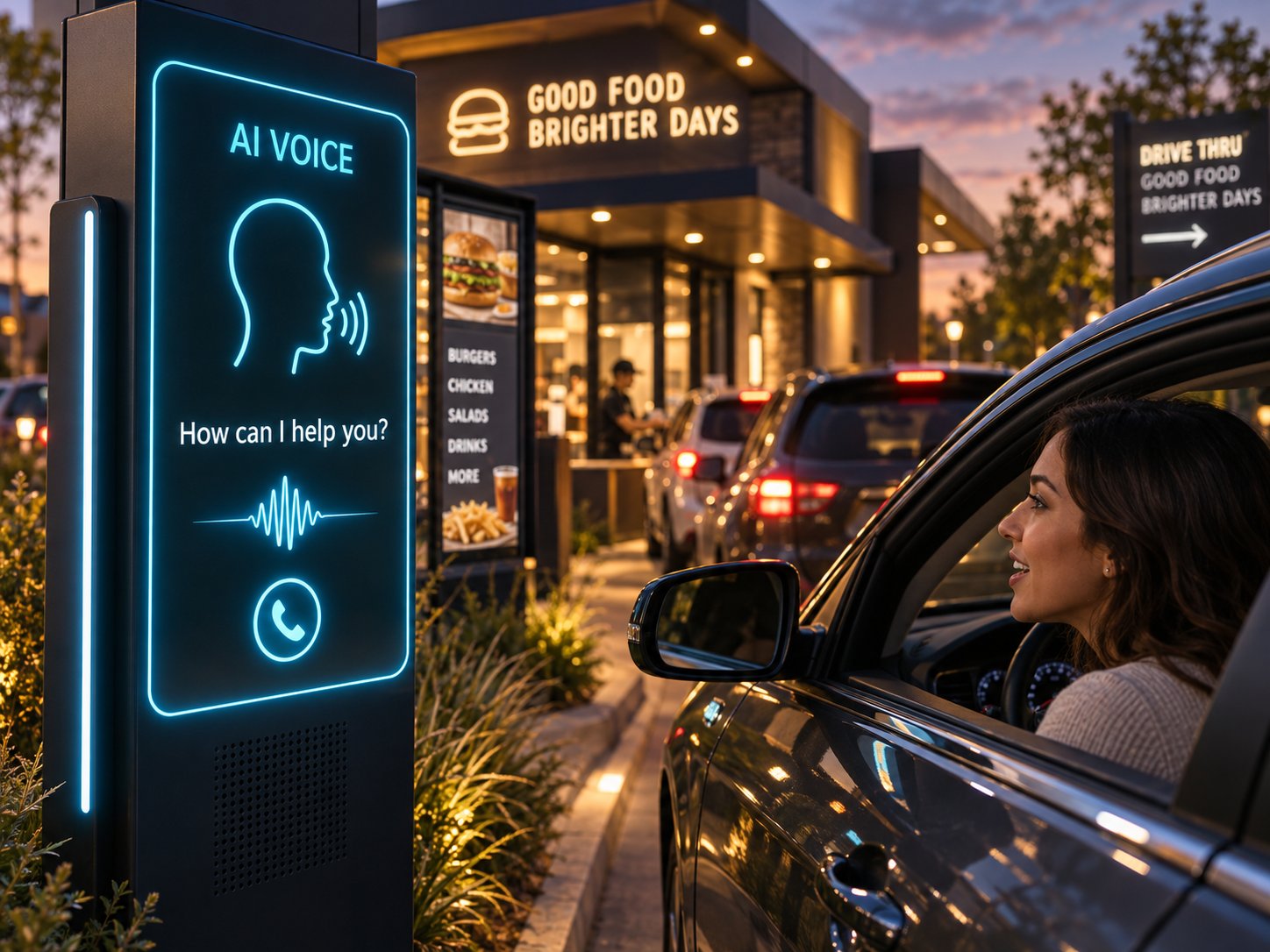
Photo: Chefs MAG original AI produced photo
Automation doesn’t remove labour — it relocates it
The underlying flaw in most voice-AI deployments is the corporate assumption that the technology replaces labour outright. It does not. In practice, it moves labour from the relatively low-stress act of taking an order to the much higher-stress act of correcting one after the fact.
When a voice AI system fails, the cognitive load transfers immediately to the shift manager or window staff, who must untangle a corrupted ticket on the fly while soothing a guest who feels they’ve just spent two minutes talking to a robot for nothing. Once a chain positions AI as the primary ordering interface rather than an experimental add-on, customers judge the entire restaurant by how well it performs. If the kitchen line, the payment lane and the staffing model can’t instantly absorb and correct the machine’s inevitable mistakes, the theoretical throughput gains disappear.
That doesn’t make voice ordering a dead end — it makes it an unfinished one. The technology needs defined boundaries: which order types it’s allowed to handle, when it hands off to a person, and how quickly that handoff happens once something goes wrong. Right now, most public deployments are being judged on raw completion rate rather than on how gracefully they fail, which is precisely backwards.
Where the technology is already working: the back of house
While front-of-house voice AI struggles with consumer trust, the back-of-house side of the same technology wave is quietly doing what it was supposed to. This is the part of the business AI is genuinely well-suited to: processing large volumes of historical data to predict outcomes, rather than parsing an unpredictable human voice in real time.
Forecasting algorithms are now routinely used to predict daily demand from historical sales, local weather and nearby events, letting managers schedule labour to the hour instead of over-staffing against uncertainty. Waste-intelligence systems are doing something similar for the bin: computer-vision cameras mounted over waste stations can categorise prep waste, overproduction and spoilage in real time, feeding that data straight back into inventory and prep-sheet decisions [1].
Neither of these applications requires the AI to have a conversation with a guest, and neither one fails publicly on video. That’s not a coincidence — it’s the actual shape of where restaurant AI currently delivers reliable value: quiet, data-heavy, back-of-house decisions, not the front-of-house moment where hospitality and error tolerance are at their thinnest.
What operators should actually be measuring
The drive-thru of the future will almost certainly be automated — the economics of prime cost make that close to inevitable. But until operators design systems that can handle human hesitation, complex modifiers and rapid correction, the technology remains a liability disguised as an upgrade. Real hospitality is invisible when it works; bad technology is deafening when it doesn’t.
Before adopting any AI ordering system, operators should ask the boring questions first: what percentage of orders are correct end-to-end, not just “unescalated”? How long does it take staff to catch and fix an AI error mid-service? What happens to a guest’s experience during that correction? A tool that scores well on completion rate but poorly on those three questions is optimising for the wrong outcome.
Automation does not remove labour from a restaurant. It reallocates it — usually to the moment things go wrong.
Why It Matters
Voice AI sits directly at the point where a guest’s patience and a restaurant’s throughput either reinforce each other or collide. For operators evaluating vendors, “completion rate” is a marketing number; “end-to-end order accuracy” and “time to human correction” are the operational ones that actually protect the brand.
What To Watch Next
Watch for chains publishing end-to-end accuracy figures rather than escalation-avoidance rates, for voice AI vendors adding built-in graceful-failure handoffs, and for back-of-house forecasting and waste-intelligence tools continuing to scale quietly while front-of-house voice ordering remains contested in public.