Hospitality’s labour shortage is no longer only a staffing problem. It is a strategic constraint involving skills, migration, management quality, scheduling, training, housing pressure and whether the sector can make long-term careers believable again. This article brings together US restaurant employment data, HOTREC’s European skills-shortage work and UKHospitality’s pressure signals to argue that serious operators need a stronger talent pipeline, not only better job adverts. The practical focus is on capability: onboarding, progression, cross-training, management development and technology that reduces friction without replacing leadership.
Highlights
- Labour shortage is now an operating-model problem, not only a recruitment problem.
- The gap includes managers, chefs, digital skills, sustainability knowledge and leadership capability.
- Policy matters, but weak onboarding, poor rotas and unclear progression remain operator problems.
- Technology helps only when it reduces friction and gives managers more control.
- The strongest employers will become more credible career builders.
Labour is now a strategic constraint
Hospitality has spent years talking about labour shortage as if it were a recruitment campaign waiting to be solved. That is no longer sufficient. The issue has moved from “can we fill the rota?” to “can the business model support the people it needs?” The distinction matters because restaurants and hotels are not only short of bodies. They are short of experienced managers, skilled chefs, digitally confident staff and people willing to see hospitality as a credible long-term career.
In the United States, the National Restaurant Association says restaurant and foodservice employment is expected to reach 15.8 million in 2026, with operators still expecting difficulty finding experienced managers and chefs [Brief-01]. In Europe, HOTREC’s labour-shortage work says the sector remains under pressure and highlights skills gaps intensified by the green and digital transitions [Brief-16]. The problem is not simply volume. It is capability.
A restaurant can operate while short-staffed for a while. It cannot build consistency if every service depends on heroic recovery. It cannot scale if management is thin. It cannot improve margins if no one has time to train, forecast, brief or analyse. Labour is therefore no longer an HR issue. It is a board-level operating risk.
The gap is not only headcount
Headcount is the easiest part to count and the least complete part to understand. A kitchen may have enough people and still lack the right skills. A dining room may be staffed and still lack leadership. A hotel may have a recruitment pipeline and still lose people because housing, scheduling, transport and progression make the job unsustainable.
HOTREC’s roadmap points to a sector where shortages are uneven by country but increasingly connected to skills: digital competences, sustainability-related knowledge, interpersonal ability and operational expertise [Brief-16] [Brief-17]. That mix is important. The restaurant of 2026 asks staff to use more systems, explain more sourcing, handle more dietary and moderation questions, work with more data and deliver hospitality with fewer friction points. The job has become more complex, not less.
This is why the old recruitment reflex underperforms. A job advert may fill a vacancy. It does not create a sous-chef, a revenue-literate manager, a confident sommelier, a digital reservations lead or a head waiter who can hold the room. The talent pipeline needs structure: training, progression, retention, scheduling, culture and leadership discipline.

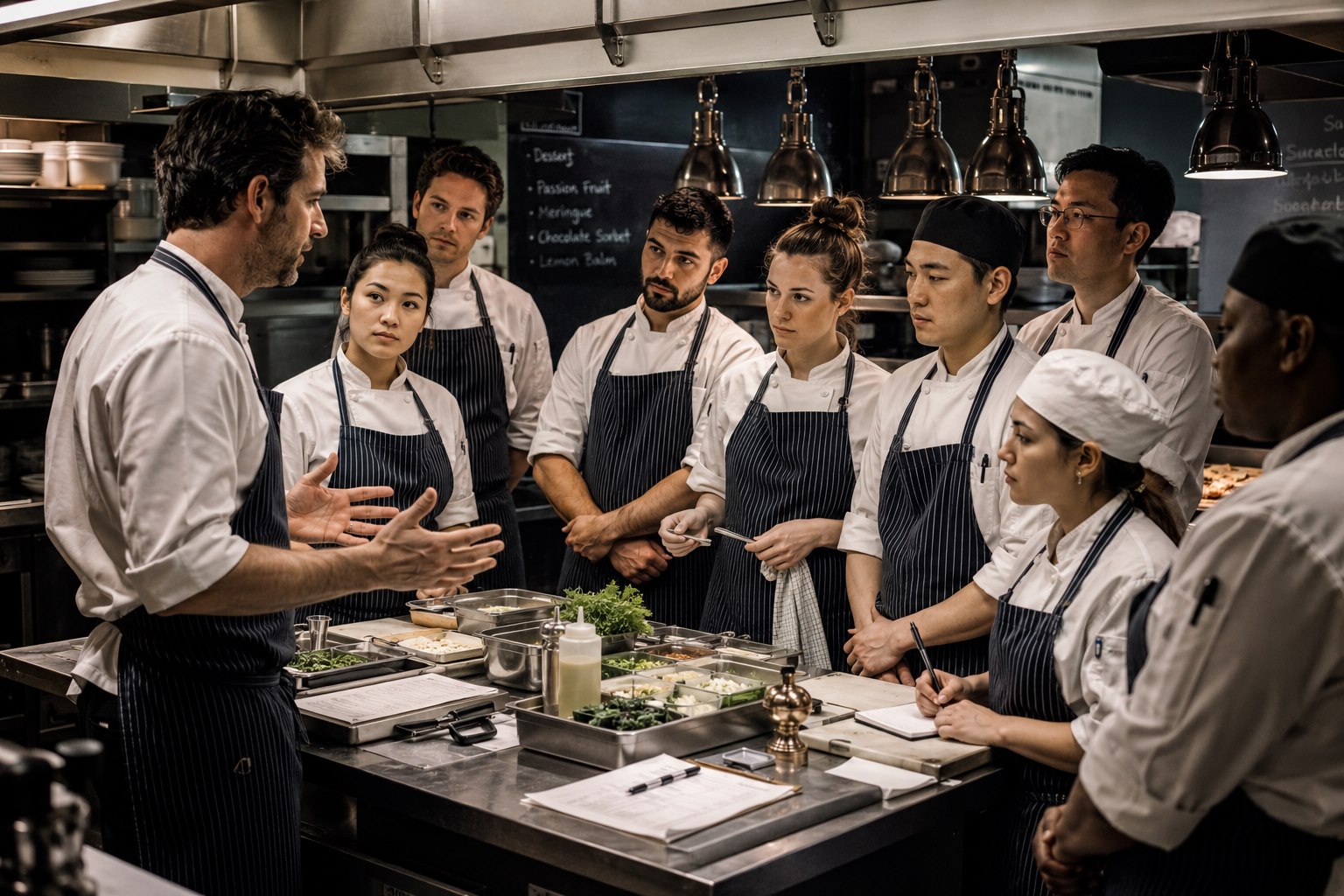
Image source: CHEFS MAG archive — original credit not recorded.
Migration, policy and local conditions matter
Labour availability is shaped by policy as much as by employer behaviour. Migration rules, wage thresholds, housing supply, transport, local cost of living and seasonal demand all decide whether hospitality can attract and retain workers. The UK policy environment, as tracked through UKHospitality’s surveys and wider parliamentary analysis, has placed employment costs, business rates and viability under continued pressure [Brief-03] [Brief-06].
Operators cannot control all of that. They can control more than they sometimes admit. Poor onboarding is controllable. Unclear progression is controllable. Bad rotas are often controllable. Weak managers are controllable. The absence of cross-training is controllable. A culture that treats exhaustion as proof of commitment is controllable.
The uncomfortable truth is that some hospitality businesses still use labour shortage as a way to avoid talking about labour quality. If a restaurant burns through staff, it does not only have a hiring problem. It has a management problem. The market may be difficult, but difficulty does not absolve operators from designing better work.
Serious operators are redesigning the work
The best operators are responding on several levels. First, they are making jobs easier to understand. A new employee should know what good looks like, who supports them, how training works and what the next step might be. This is basic, but many businesses still rely on oral tradition and pressure.
Second, they are reducing avoidable friction. Technology can help when it removes repetitive tasks, improves forecasting, supports scheduling or captures routine guest information. It cannot replace leadership. Deloitte’s work on restaurant resilience places technology inside a broader operating response to cost and complexity [Brief-05]. That is the correct frame. A scheduling tool is useful if it improves the rota and reduces manager drag. It is not useful if it only gives a weak manager a more expensive spreadsheet.
Third, strong operators are rethinking station design and service models. A kitchen or dining room that depends on too many narrow roles may become fragile when labour is tight. Cross-trained teams, clearer mise-en-place, better prep planning, shorter menus and simpler service rituals can reduce strain without reducing hospitality.
Fourth, they are taking management more seriously. The industry often promotes talented chefs and servers into leadership and then gives them little support. That is expensive. Poor management drives turnover, weakens standards and makes recruitment harder because reputation travels quickly.
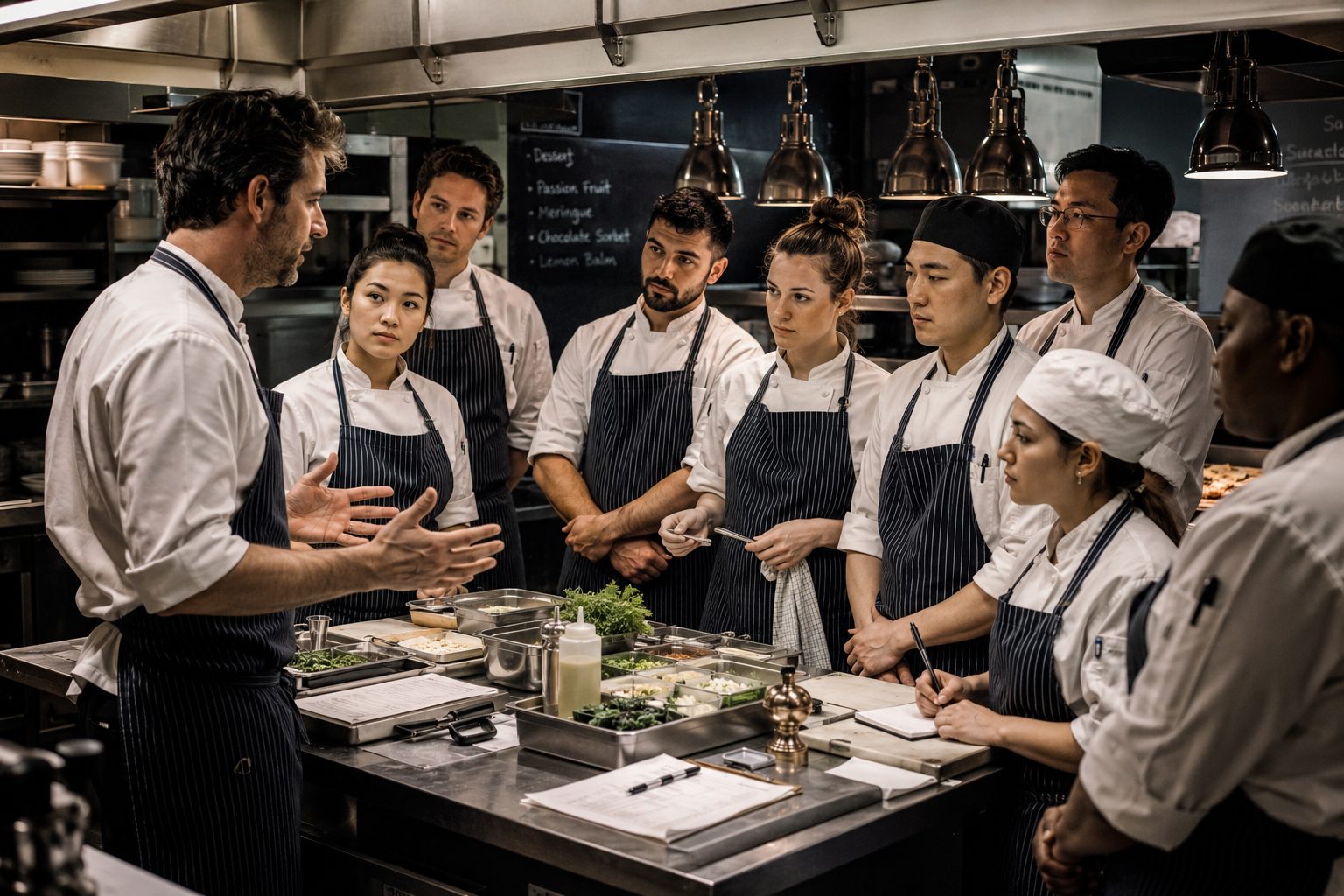
Image source: CHEFS MAG archive — original credit not recorded.
What policy can and cannot solve
Policy can improve the labour environment. Training incentives, apprenticeship reform, migration clarity, fairer business rates, support for transport and housing, and recognition of hospitality’s economic contribution all matter. UKHospitality’s economic contribution material exists because the sector needs to demonstrate its broader value, not only plead for relief [Brief-18].
But policy cannot fix a restaurant that does not train. It cannot make a chaotic rota feel professional. It cannot turn a vague job into a credible career. It cannot protect culture if the owner treats every staff issue as a cost rather than a capability question.
The practical approach is therefore dual. Trade bodies should continue arguing for viable policy conditions. Operators should meanwhile redesign the work as if rescue is not coming. The businesses that wait passively will remain exposed. The businesses that build better internal pipelines will still face shortage, but they will be less fragile.
What Chefs MAG should watch through 2026
The most important signal is not the number of vacancies alone. It is whether hospitality employers are becoming more believable as career builders. Watch apprenticeship quality. Watch management training. Watch whether chefs stay in kitchens after becoming parents. Watch whether service professionals can progress without moving into head office. Watch whether digital tools improve work or simply monitor it.
Also watch the language. Businesses that still describe labour only as a cost will struggle to create loyalty. Businesses that describe labour as capability have a better chance. The difference is not sentimental. Capability is what protects margin, service consistency, guest memory and growth.
Labour is no longer a recruitment problem; it is an operating model problem. The restaurants and hotels that understand this will build clearer roles, better training, more intelligent schedules and stronger management. The rest will keep hiring into the same leak.
Retention begins before the first service
Retention is often discussed too late, after the strongest people have already started looking elsewhere. In reality, it begins before the first service. The interview, contract, induction, first rota, first correction and first moment of pressure all tell the employee what kind of business they have joined. If those moments are improvised, the employer brand is improvised too.
A stronger pipeline begins with clearer promises. Do not sell mentorship if the senior team has no time to teach. Do not promise progression if there is no structure for it. Do not claim flexibility if the rota punishes people who need predictability. Hospitality can still be demanding; serious professionals know that. What is harder to accept is avoidable chaos disguised as tradition.
Training also needs to become less romantic and more practical. A cook should understand not only the dish but the cost of waste, the reason for portion discipline and the service consequence of poor prep. A server should understand not only ingredients but margin-sensitive selling, pacing, allergy confidence and the way guest notes affect repeat business. A manager should understand labour, morale, complaint recovery, technology and commercial rhythm.
This is where technology and talent connect. Scheduling software, training platforms, forecasting tools and communication systems can make work clearer. They cannot compensate for weak leadership. Used well, they reduce ambiguity. Used badly, they become another form of pressure. The practical question is whether a tool helps people do better work with less confusion.
The operators worth watching will be those that make hospitality careers feel serious again. That does not require corporate language. It requires visible standards, honest progression, better management habits and enough respect for the work to design it properly. This is also a reputation question. Chefs talk, managers talk and service teams talk. A restaurant known for teaching well and treating people seriously has a quieter recruitment advantage than any campaign can buy. In a tight labour market, that reputation compounds. In a weak culture, the opposite compounds just as quickly. For owners, this changes the weekly agenda. Talent should not appear only when there is a vacancy. It should sit beside revenue, margin and guest feedback. Who is progressing? Who is at risk of leaving? Which manager needs support? Which station is consistently fragile? These questions are operational, not sentimental. The measurable goal is simple: fewer repeated vacancies, faster competence, stronger internal promotion and less service quality lost between recruitment cycles.
Labour is no longer a recruitment problem; it is an operating model problem.
Why It Matters
For owners and leaders, the article shifts the talent conversation from vacancy filling to capability building. It gives practical emphasis to training, scheduling, cross-skilling, management and the credibility of hospitality careers.
What To Watch Next
Watch for stronger employer brands, more serious apprenticeship pathways, better management training, cross-trained teams and operational technology that makes work clearer rather than simply more monitored.
Sources & Further Reading
- [Brief-01] National Restaurant Association 2026 state report
- [Brief-02] National Restaurant Association 2026 press release
- [Brief-03] UKHospitality quarterly members survey
- [Brief-05] Deloitte building restaurant resilience
- [Brief-06] House of Lords Library on hospitality and retail policy
- [Brief-16] HOTREC labour shortages roadmap
- [Brief-17] HOTREC policies social affairs
- [Brief-18] UKHospitality economic contribution