Europe’s 2026 wine package gives alcohol-free and alcohol-reduced wine clearer language, and that matters for restaurants. The change does not make every bottle better, but it gives producers, buyers, sommeliers and guests a more stable vocabulary. This article explains the commercial implications: clearer labels, better list architecture, more precise staff training and a stronger basis for premium alcohol-free wine to sit inside a serious beverage programme. The category still needs quality, but it now has more regulatory runway and less room for vague menu language.
Highlights
- EU measures clarify use of alcohol-free, 0.0% and alcohol-reduced language.
- Clearer language improves guest trust and staff confidence.
- Restaurants should separate alcohol-free wine, alcohol-reduced wine and non-alcoholic pairings.
- Regulation helps the category, but quality still has to be judged glass by glass.
- Better labelling can support premium positioning when the drink earns it.
The label has become part of the service
Alcohol-free wine has not lacked ambition. It has lacked stable language. Producers have been moving faster than regulation, buyers have been trying to understand quality and guests have often faced labels that required explanation before they could make a confident choice. In 2026, the European wine package gives the category a clearer vocabulary, and that matters more than it sounds.
The European Parliament says that under the new measures, products at no more than 0.05% ABV may use the term “alcohol-free” together with the expression “0.0%”, while products above 0.5% ABV but at least 30% below the standard alcoholic strength of their category may be labelled “alcohol reduced” [Cellar-19]. That language is technical, but in hospitality technical clarity often becomes service clarity. A sommelier can explain the bottle. A buyer can categorise the list. A guest can understand the choice.
This article is not an argument that regulation solves flavour. It does not. It is an argument that clearer rules give producers, restaurants and retailers a more stable framework for building trust. Without trust, alcohol-free wine remains a curiosity. With trust, it can become part of programme design.
What the EU changed in 2026
The important change is not only the specific ABV threshold. It is the act of separating terms that guests, producers and buyers often use loosely. “Alcohol-free”, “0.0%”, “dealcoholised” and “alcohol reduced” do not all mean the same thing in service, and they should not be treated as interchangeable on a wine list.
For restaurants, the distinction matters because beverage teams are the translators between regulation and the table. A guest does not want a legal lecture. They want to know whether a wine contains alcohol, how much, why it tastes the way it does and how it will work with the food. Clearer labelling gives the team a safer foundation for that conversation.
The Council of the EU framed its February 2026 approval as part of a wider effort to support a more modern, resilient and innovation-friendly wine sector, responsive to new consumer preferences [Cellar-20]. That phrase matters for the on-trade. Reduced-alcohol and alcohol-free wine are not being treated only as niche wellness products. They are part of how the wine sector is being asked to adapt.
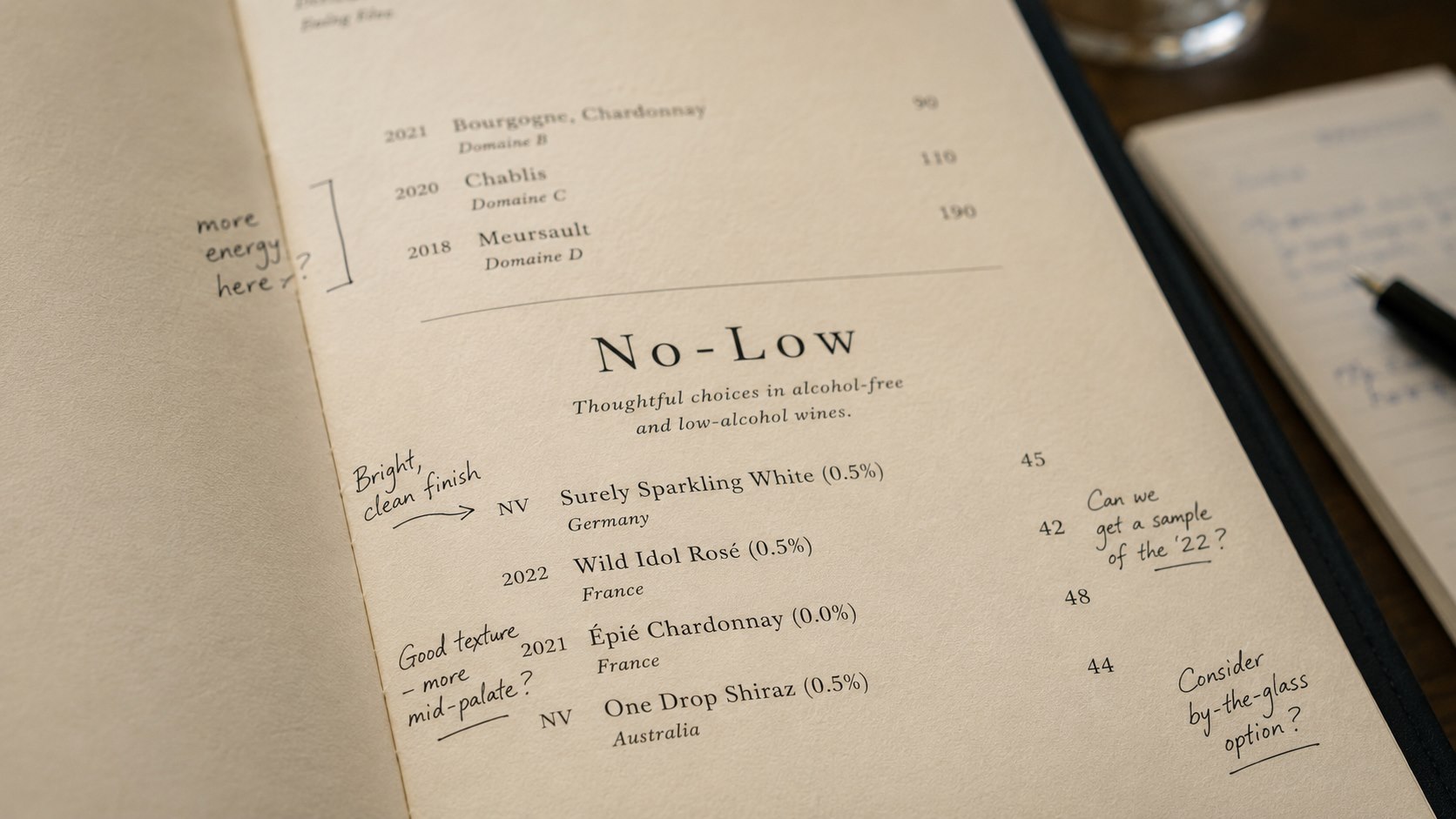
Image source: CHEFS MAG archive — original credit not recorded.
Why clearer language matters commercially
Commercially, unclear language creates friction. Friction slows service, weakens the hand-sell and reduces confidence. If a guest asks for alcohol-free wine and the team is uncertain whether a bottle is 0.0%, dealcoholised, low-alcohol or simply lighter in ABV, trust begins to leak. That leak may seem small, but in premium hospitality small uncertainty is expensive.
Clear language allows the list to be arranged more intelligently. A restaurant might separate alcohol-free wine, alcohol-reduced wine and other non-alcoholic pairings. It might use a simple note explaining ABV thresholds. It might train staff to ask whether the guest is avoiding alcohol entirely or choosing moderation. Those are different needs, and the programme should respect the difference.
There is also a pricing implication. Guests are more willing to consider premium alcohol-free wine when the category is explained clearly. If the bottle seems vague, it competes with soft drinks. If it has a defined production method, category language and food role, it can sit closer to wine. The price still has to feel earned, but the explanation becomes easier.
How producers and restaurants can use the rules well
Producers should resist the temptation to hide behind compliance. A label can be legal and still unhelpful. The best bottles will communicate alcohol category, production method, style, sweetness, serve temperature and pairing use without overwhelming the guest. Restaurants should do the same on the list. The aim is not to reproduce legislation. It is to turn legislation into confidence.
The European Commission has published a study on low/no alcohol beverages [Cellar-21], while OIV has formal material around dealcoholisation of wines [Cellar-22]. For buyers, these references are useful because they show that the category now sits within a broader institutional conversation, not only a marketing cycle. That matters when building a serious programme for hotels, fine dining, clubs or destination restaurants.
Labels, menu language, cellar categorisation and guest trust
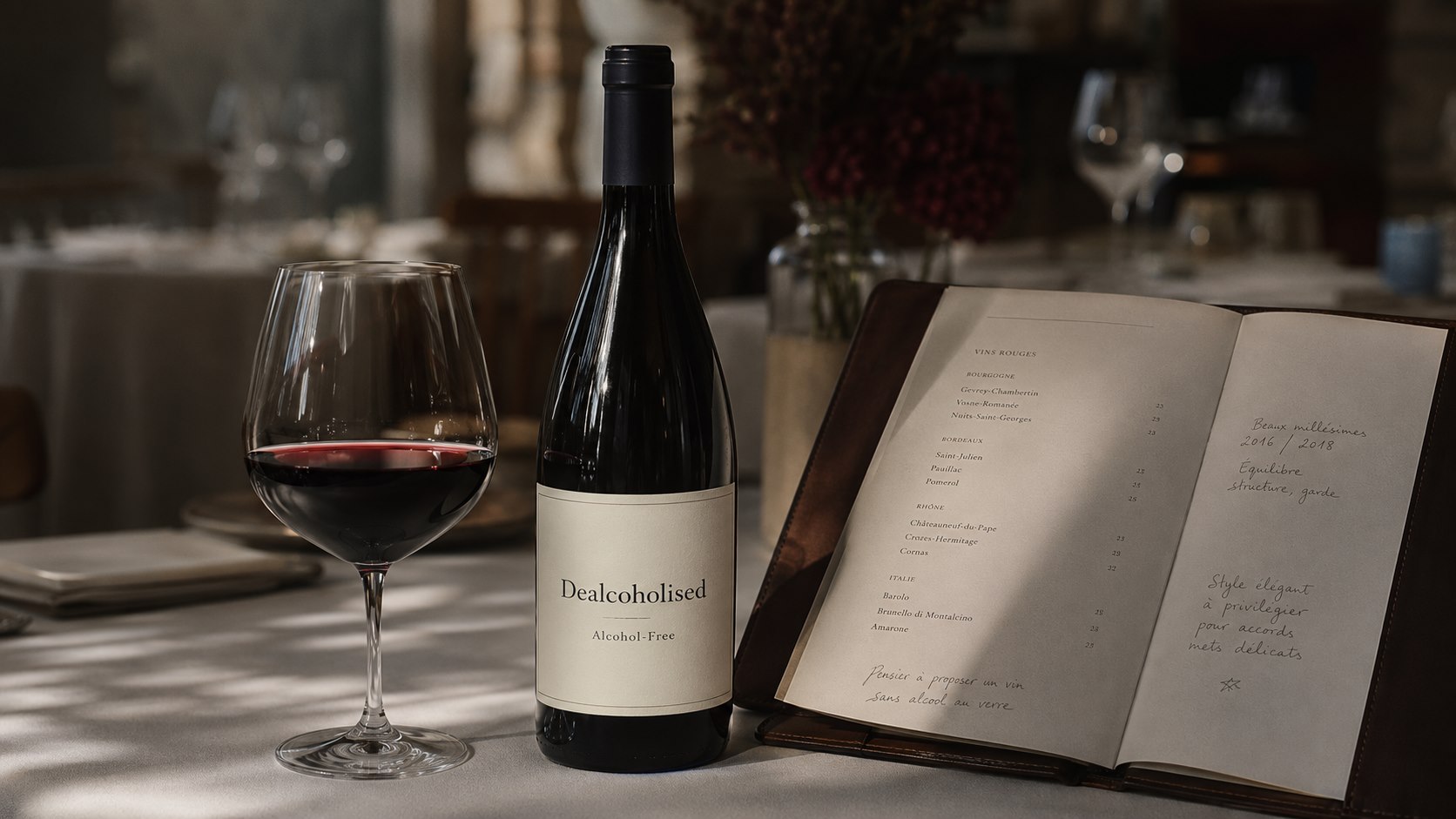
A practical list might use plain terms first: Alcohol-Free Wine, Alcohol-Reduced Wine, Non-Alcoholic Pairings. It can then add short notes where needed. The guest should not need to decode the category. If a bottle is 0.0%, say so. If it is alcohol-reduced, say so. If it is not wine but belongs in the no-alcohol pairing sequence, do not pretend otherwise.
This also protects staff. When language is clean, training becomes easier. The team can explain what the drink is, why it is there and where it sits in the meal. The result is better than euphemism. Guests know when a restaurant is avoiding clarity. A serious beverage programme should not make them ask twice.
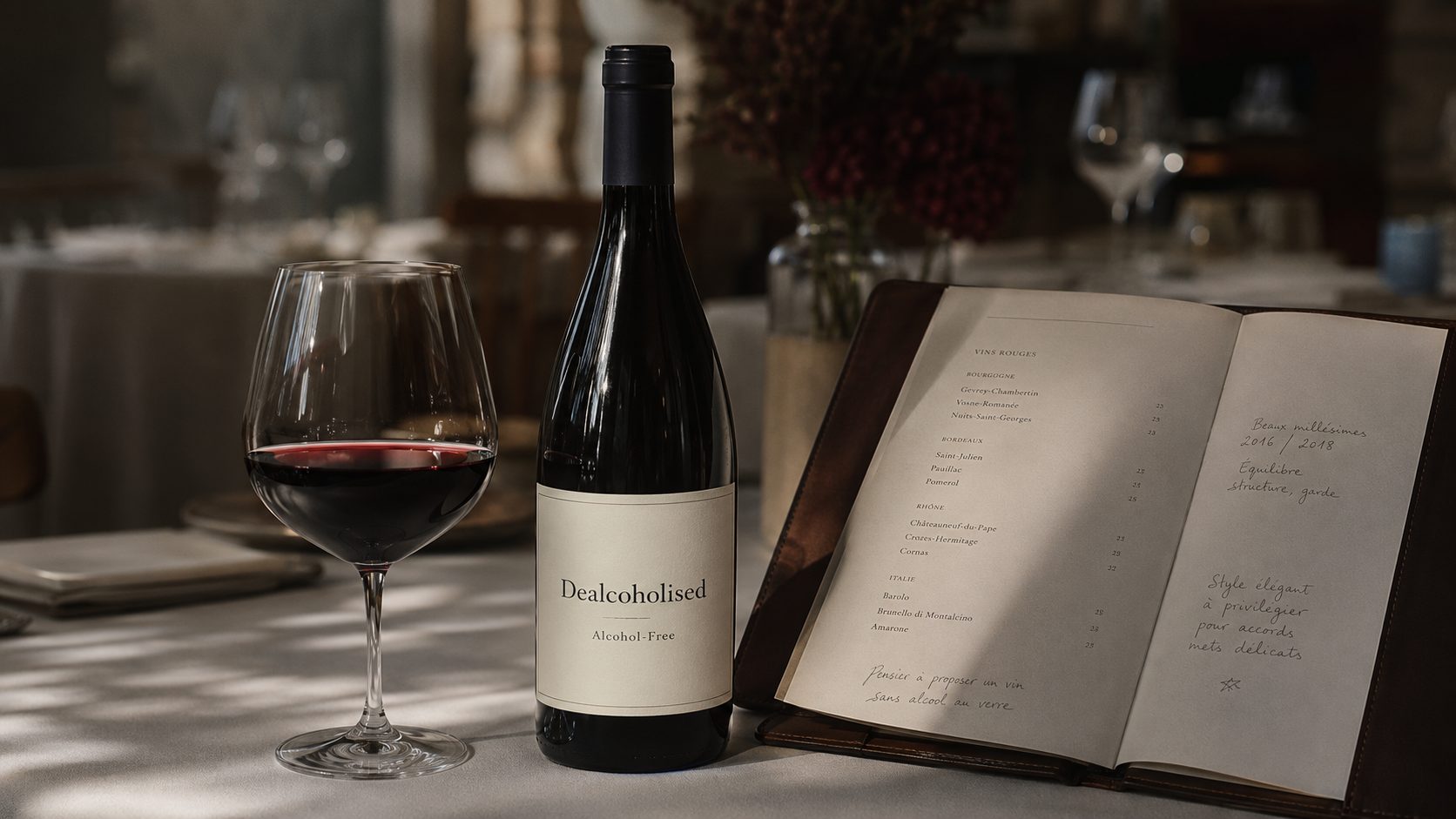
Image source: CHEFS MAG archive — original credit not recorded.
Where product quality still needs improvement
Regulatory language can make the category easier to trust, but it cannot make weak wine taste better. Dealcoholisation remains a technical challenge because removing alcohol changes body, aroma, texture and balance. Some bottles compensate with sweetness, some with acidity, some with carbonation, and some still feel thin. Buyers need to taste carefully rather than assume the category has matured evenly.
This is where the restaurant’s standards matter. A wine list should not accept a bottle because the label is now clearer. It should accept it because the drink works. Does it have enough texture? Does it finish cleanly? Does it work with food? Does the guest understand the price? Does it add something that a tea, shrub, kombucha or botanical drink cannot do better?
IWSR’s no-alcohol growth context helps explain why the category deserves attention [Cellar-23], while OIV’s wider wine-sector adaptation material shows that low/no and innovation are part of the sector’s response to changing consumption [Cellar-24]. But growth is not permission to list everything. It is permission to build a better filter.
What this means for the next two years
The next phase will be shaped by three forces: clearer rules, better products and more confident service. Restaurants that move early can build credibility before the category becomes crowded. Producers that communicate clearly can help buyers understand where their bottles belong. Guests who once avoided the category may begin to trust it when the language stops feeling improvised.
For Chefs MAG readers, the practical conclusion is simple. Alcohol-free wine now has more runway, but the runway is not the same as arrival. The category needs buying discipline, honest language and service training. Clearer rules give alcohol-free wine a language the guest can trust. The restaurant still has to make that language useful at the table.
The buyer’s risk is ambiguity
For buyers, ambiguity is the real commercial risk. A bottle that sits between alcohol-free, alcohol-reduced and simply low alcohol may be technically interesting, but if the category cannot be explained quickly it becomes hard to sell. In a premium restaurant, uncertainty at the table is rarely neutral. It makes the guest pause, and the pause often becomes a safer order.
The solution is not to turn the wine list into a regulatory document. It is to make the structure legible. A short introduction can explain how the restaurant defines alcohol-free and alcohol-reduced. Staff notes can carry more detail for those who ask. The public list should remain elegant, but it should not hide the facts a guest needs in order to trust the pour. This is especially important for guests avoiding alcohol completely, where “low” and “free” are not interchangeable choices.
Producers also have a role. The most useful bottles for restaurants will be those that help the buyer understand not only ABV, but also style, body, sweetness, acidity and ideal service temperature. A premium category cannot rely on absence alone. It has to communicate presence: what the drink brings to the meal. That is where the next phase of alcohol-free wine will be won or lost.
This is especially important for hotels and destination restaurants, where guest motivations vary widely. One table may want full abstinence for personal or religious reasons. Another may be moderating during a long business lunch. Another may simply be curious. The list should allow the team to serve all three without awkwardness. Clear categories are not bureaucracy; they are hospitality.
There is also a reputational benefit. A restaurant that handles alcohol-free language carefully signals that it takes guest choice seriously. In an era of moderation, that care can matter as much as bottle depth.
That is the commercial discipline. For operators, the practical decision is not whether to follow the category, but how to make its language usable in service without turning the list into paperwork. It also gives the editor a cleaner audit trail. That discipline will matter in service, training and buyer review. That clarity protects guest trust.
Clearer rules give alcohol-free wine a language the guest can trust.
Why It Matters
For sommeliers, buyers and restaurant operators, this piece explains how regulation changes the practical language of the list: categories, ABV clarity, staff training, guest confidence and premium positioning.
What To Watch Next
Watch for clearer menu sections, better producer label language, more careful buyer tastings and alcohol-free wines moving from token placements into structured no/low beverage programmes.
Sources & Further Reading
- [Cellar-19] European Parliament wine-sector measures
- [Cellar-20] Council of the EU wine package
- [Cellar-21] European Commission study on low/no alcohol beverages
- [Cellar-22] OIV dealcoholisation of wines
- [Cellar-23] IWSR no-alcohol growth context
- [Cellar-24] OIV wine sector adaptation and low/no context