
The front door of the restaurant is no longer only the host stand, the website or the reservation widget. AI discovery, restaurant-profile questions, voice booking and in-vehicle reservations are beginning to reshape how guests move from intent to table. OpenTable’s AI tools, Concierge product and voice AI work show the direction: routine questions, missed calls and pre-booking uncertainty are becoming conversion problems rather than background noise. The opportunity is practical, but fragile. Restaurants need machine-readable content, accurate answers, clean booking flows and a brand voice that still feels like hospitality.
Highlights
- Restaurant discovery is moving from search bars into AI answers, profiles, phones and voice interfaces.
- FAQs are becoming conversion assets, not just support content.
- Voice AI matters because missed calls can now be treated as measurable lost revenue.
- Accuracy, tone and escalation rules are critical to protect hospitality.
- AI should support the front door, not replace responsibility for the guest relationship.
The new front door is not always a door
For most of restaurant history, the front door was physical. Then it became a website, a booking widget, a review platform and a social feed. In 2026 it is becoming something less visible: an answer generated by an AI assistant, a restaurant profile that can respond to questions, a phone line that books tables without a host, or a car dashboard that turns a spoken request into a reservation.
That does not make the maître d’ obsolete. It changes where the first act of hospitality happens. Before a guest reaches the room, they may ask whether the terrace is covered, whether a counter menu can be booked, whether there is a pre-theatre sitting, whether the restaurant can handle a dietary restriction, or whether a table is available on the way across town. If those answers are slow, vague or missing, the guest may never arrive.
OpenTable has made this shift unusually concrete. Its materials describe AI tools designed to support restaurants, including pre-booking assistance and operational relief for routine questions [Lab-07]. Its Concierge product is positioned as a dining assistant using OpenTable data across a large restaurant network to answer guest questions before booking [Lab-08]. Its voice AI product frames phone capture as part of reservation management rather than a side feature [Lab-09] [Lab-11]. SoundHound’s OpenTable integration adds another signal: booking journeys are also moving into voice environments outside the restaurant website [Lab-10].
The implication is simple. Restaurant content is becoming an operating surface.
Discovery is moving from search to answer
Traditional restaurant search rewarded pages that ranked. AI discovery rewards information that can be understood, trusted and acted upon. This changes the role of menus, FAQs, opening hours, accessibility details, private dining pages, event listings, dress codes, deposit policies and dietary notes. They are no longer only reader-facing. They are also machine-facing.
That is not a reason to write like a database. It is a reason to make the restaurant’s facts clearer. The best hospitality brands will not surrender tone; they will structure tone. A restaurant can still sound refined, intimate or energetic while making its practical information unambiguous enough for AI systems to interpret.
The risk is that many restaurants still treat their website as a brochure and their reservation profile as an afterthought. In an AI-led discovery environment, that becomes expensive. If an assistant cannot understand what the restaurant offers, it may not recommend it. If a restaurant profile cannot answer common pre-booking questions, the guest may choose a competitor with clearer information. If a phone goes unanswered during service, the table may be lost.
This is why local SEO and GEO are beginning to merge for hospitality. Search visibility now depends not only on keywords, but on entities, clarity, consistency and confidence. A restaurant must teach machines what the staff already knows.
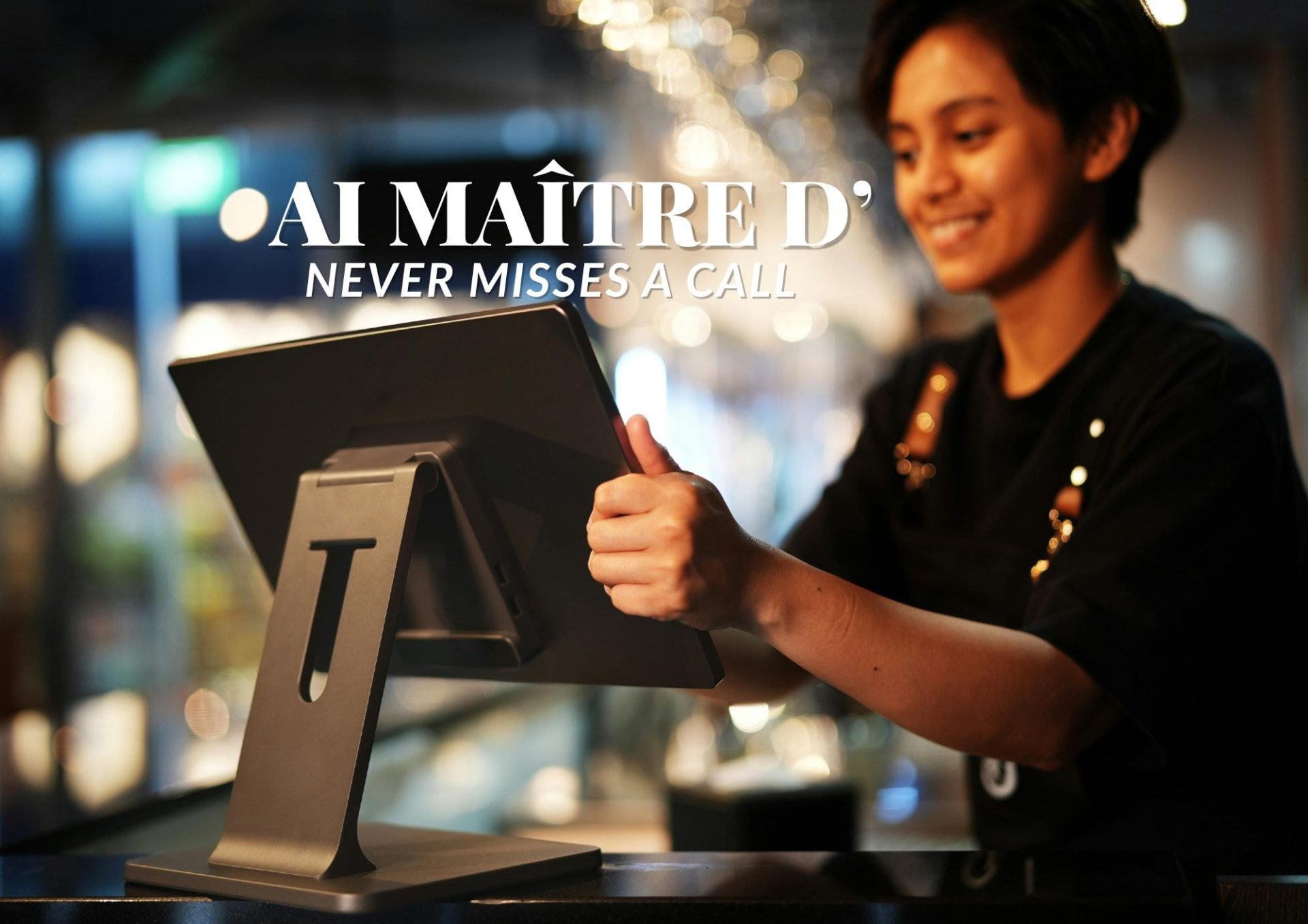
Design: Chefs MAG.
Voice AI turns missed calls into a management issue
Restaurants have long accepted missed calls as part of service. The phone rings during prep, lunch, briefing, peak service or close. Some calls are low-value. Some are repetitive. Some are urgent. Some are bookings that disappear because nobody had time to answer.
Voice AI changes the way that problem is framed. OpenTable presents voice AI as a tool that can answer calls, handle routine questions and support booking capture around the clock [Lab-09] [Lab-11]. Whether a restaurant chooses OpenTable, another provider or no provider at all, the management question is now unavoidable: how much demand is being lost at the phone line?
This is not only about answering more calls. It is about knowing which calls deserve human escalation, which can be automated, and which questions reveal that the restaurant’s public information is unclear. If guests repeatedly call to ask about parking, terrace weather, tasting-menu duration or allergens, the issue may not be the phone. The issue may be the content architecture.
A serious voice AI setup therefore needs rules. Which booking sizes can it handle? When does it transfer to a person? What language is acceptable? How are dietary questions phrased? What happens with deposits, cancellations, private dining, accessibility or VIP notes? A restaurant cannot outsource judgement to a tool and hope hospitality survives.
The profile becomes a bookable interface
The restaurant profile is also changing. It used to be a listing. It is becoming a semi-active interface. If a guest can ask a profile whether the restaurant has bar seating, child policies, counter reservations, tasting menus or late tables, the profile is no longer passive. It is part of the host function.
OpenTable’s AI Concierge is important because it points in this direction: guests want pre-booking confidence without clicking through multiple pages or waiting for a reply [Lab-08]. Toast’s broader writing on AI for restaurant operations points to a similar logic inside operations: AI is useful when it reduces repetitive work and improves decision flow [Lab-12]. Taken together, the pattern is clear. The best AI restaurant reservations tools will not be judged only by novelty. They will be judged by whether they remove friction between interest and confirmed table.
For operators, the content implications are practical. Restaurant profiles need accurate descriptions, current menus, correct opening hours, clean photography, clear policy language and FAQ-level specificity. The staff should know what the AI says, and the AI should not say anything the staff cannot honour.
This is where brand voice matters. A cold answer can technically solve a question while damaging the mood. A vague answer can preserve tone while failing the booking. The better solution is controlled clarity: concise, accurate, human enough, and always able to hand over to a person when judgement is required.
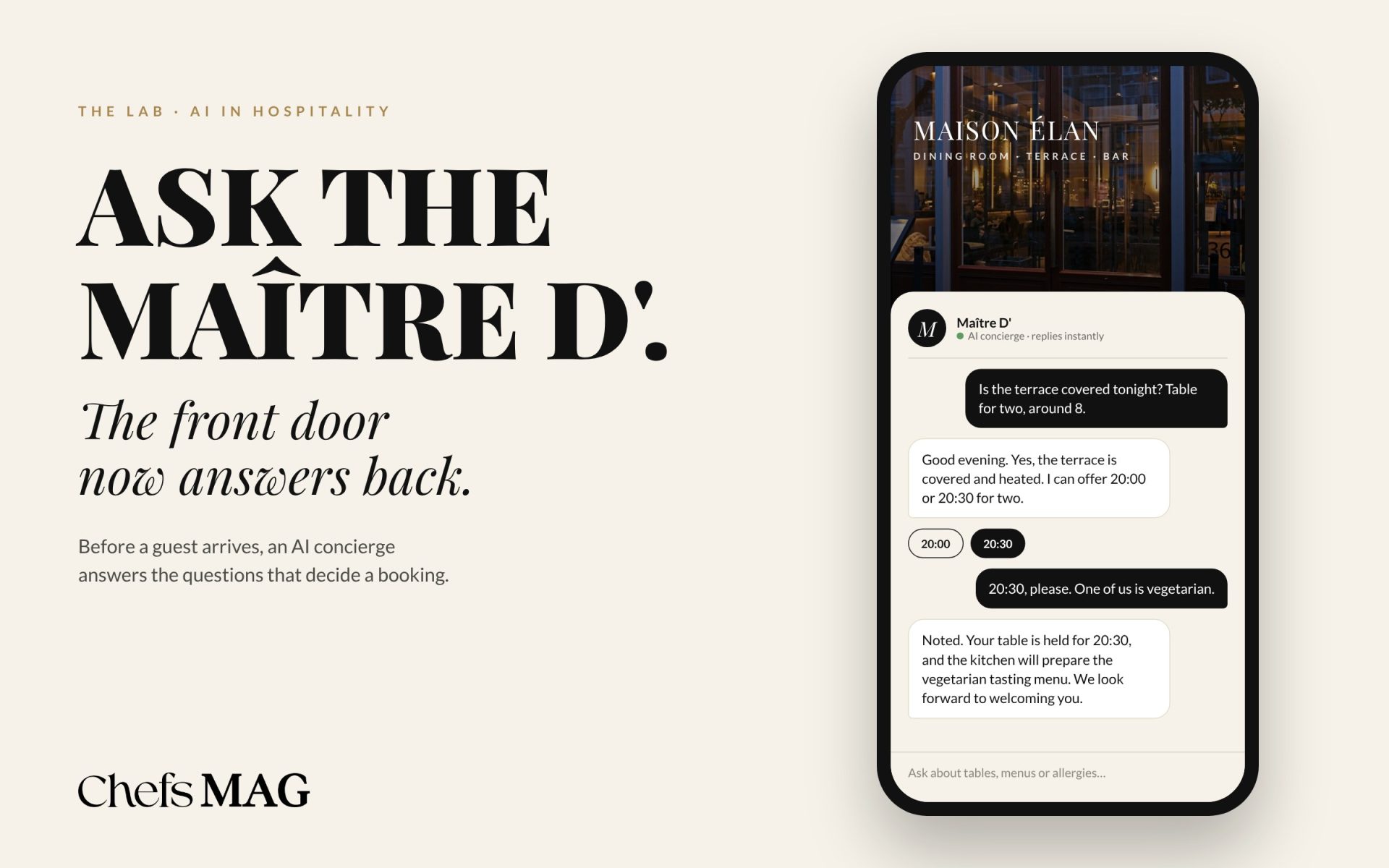
Illustration: Chefs MAG.
Accuracy is the new hospitality risk
The danger in this category is not that AI exists. The danger is that it answers with confidence when the restaurant has not given it enough truth. A wrong opening time, inaccurate allergen statement, invented policy or misunderstood deposit rule can create more damage than a missed call. Automation compresses friction, but it also compresses error.
Restaurants should therefore treat AI-facing information as controlled content. The same care given to menu wording should be given to practical data. Hours, closures, special events, private dining capacities, booking windows, terrace rules, corkage, accessibility and dietary policies should have one source of truth. If the website says one thing, the reservation platform another and the team a third, AI will expose the disorder.
There is also a tone risk. Some restaurants are casual, some theatrical, some highly formal. AI answers need to respect that difference without becoming cute. The goal is not to make every restaurant sound like a chatbot. It is to give guests useful answers in a tone that does not break the brand.
A practical adoption checklist
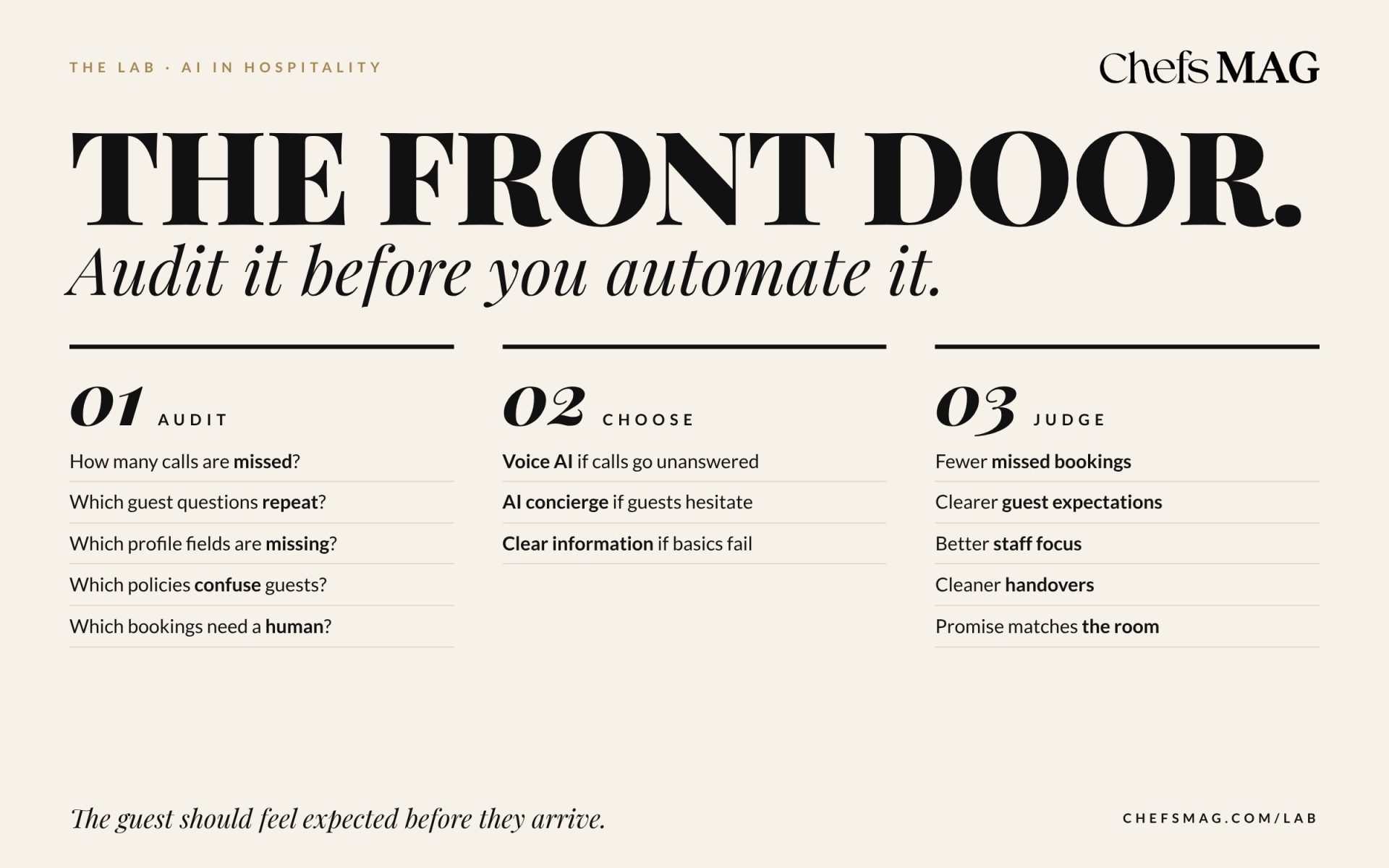
Diagram: Chefs MAG.
The first step is not to buy the most advanced tool. It is to audit the current front door. How many calls are missed? Which questions repeat? Which profile fields are incomplete? Which pages are outdated? Which policies create confusion? Which bookings require a human? Which ones do not?
Only then should the operator choose technology. A voice tool may be useful if the phone is a real source of lost demand. An AI concierge may be useful if the restaurant’s profile attracts high-intent but uncertain guests. A structured FAQ may be more important than either if the restaurant’s basic information is poor.
The new AI maître d’ should be judged by hospitality outcomes: fewer missed bookings, clearer guest expectations, better staff focus, cleaner handovers and a stronger relationship between digital promise and dining-room reality. The front door may now be a voice prompt, a profile answer or a recovered missed call. The responsibility remains the same. The guest should feel expected before they arrive.
The first audit is not technical
A restaurant considering AI at the front door should not begin with software. It should begin with a list of guest questions. What do people ask before booking? Which questions are answered well by the website? Which ones force a phone call? Which ones create hesitation? Which ones require judgement? The answer will usually reveal that the restaurant’s content is less clear than the team assumes.
The next step is to decide what should never be automated. Allergy handling, sensitive complaints, VIP requests, complex private dining, press enquiries and unusual accessibility needs may require human review. That does not mean AI cannot help route them. It means the escalation rule must be designed before the tool goes live. The most dangerous version of restaurant AI is not the simple one. It is the confident one with no boundary.
The team also needs a maintenance rhythm. Menus change, terrace policies change, opening hours change, deposits change, event calendars change. If the AI pulls from stale information, the restaurant will automate confusion. Someone must own the weekly content check, just as someone owns the reservation book. In that sense, the AI maître d’ is not a plug-in. It is a new operational surface that needs stewardship.
The new front door of the restaurant may be a voice prompt, a profile answer or a missed call recovered.
Why It Matters
AI reservation tools sit directly between guest intent and revenue. For operators, this makes content accuracy, phone capture and AI answer quality part of commercial hospitality. The article gives restaurants a practical way to think about AI as a front-door system rather than a novelty.
What To Watch Next
Watch AI concierge products, voice reservations, in-vehicle booking, restaurant-profile Q&A and structured website FAQs. The important signals will be booking conversion, guest satisfaction, escalation rules and whether operators maintain one reliable source of truth.
Sources & Further Reading
- [Lab-07] OpenTable AI tools support restaurants
- [Lab-08] OpenTable AI Concierge article
- [Lab-09] OpenTable voice AI product page
- [Lab-10] SoundHound x OpenTable in-vehicle reservations
- [Lab-11] OpenTable support: using voice AI
- [Lab-12] Toast AI for restaurant operations