Michelin’s 2026 Great Britain and Ireland selection gives a strong lens on space as part of gastronomy. The official Michelin release says Bonheur by Matt Abé and Row on 5 were newly awarded Two Stars, with Row on 5 described as a collaboration between Jason Atherton and Spencer Metzger. It also notes The Pullman in Galway, where Angelo Vagiotis’ cooking is served inside two original Orient Express train carriages, and Restaurant Gordon Ramsay High, known for views from the 60th floor. The article asks how setting becomes part of the restaurant’s argument without overwhelming the food.
Highlights
- Michelin’s 2026 Great Britain and Ireland release says Row on 5 was newly awarded Two Stars [Pass2-09].
- Michelin describes The Pullman in Galway as serving Angelo Vagiotis’ cooking in two original Orient Express train carriages [Pass2-09].
- Michelin notes Restaurant Gordon Ramsay High’s 60th-floor views and Chef James Goodyear’s cooking [Pass2-09].
- The article treats space as an editorial and operational tool, not a substitute for cooking.
The room is no longer neutral
Restaurants have always used setting. A dining room can soften a guest before the first course, make service feel more intimate, or allow a kitchen to borrow authority from architecture, history or view. What feels different now is how deliberately space is being used as part of the restaurant’s public argument. The room is no longer simply the container for the meal. In the strongest cases, it explains why the meal should exist there.
The Michelin Guide Great Britain and Ireland 2026 gives several useful examples. Michelin’s official release says Row on 5 was newly awarded Two Stars, joining Bonheur by Matt Abé in that category [Pass2-09]. The Row on 5 Guide profile places the restaurant on Savile Row and describes premises fitted out with no-expense-spared luxury [Pass2-12]. Elsewhere, Michelin’s release notes The Pullman in Galway, where Angelo Vagiotis’ cooking is served in the setting of two original Orient Express train carriages [Pass2-09]. The Pullman’s own Guide profile describes the setting as lovingly restored Orient Express carriages dating back nearly 100 years [Pass2-13]. Michelin also highlights Restaurant Gordon Ramsay High, known for views from the 60th floor, while making clear that Chef James Goodyear’s cooking is central to the recognition [Pass2-09].
These are not identical restaurants, and Michelin does not present them as a design movement. But together they help show how spatial narrative is moving closer to the centre of the dining conversation.
Height, history and procession
The three spatial signals are different. Height gives a restaurant instant drama. A 60th-floor setting changes the guest’s physical relationship with the city before the menu begins. Restaurant Gordon Ramsay High can use that height as an arrival ritual, but Michelin’s wording is careful: the view may be known, yet Goodyear’s cooking is “no footnote” [Pass2-09]. That caveat matters. A room can bring the guest in, but the plate must keep them there.
Heritage works differently. The Pullman’s setting in two original Orient Express train carriages gives the restaurant a narrative that begins before service [Pass2-09]. Michelin’s separate feature on the restaurant identifies the carriages as Leona, from the original 1927 train, and Linda, from 1954 [Pass2-14]. The guest is not merely seated; the guest enters a memory of travel, craft, enclosure and occasion. For a restaurant, that creates both opportunity and risk. The setting can make dinner feel singular, but it can also become too loud if the food appears secondary.
Row on 5 offers a third model: procession. Michelin describes it as a luxurious experience from start to finish, backed by serious depth and quality [Pass2-09]. The restaurant profile reinforces the spatial signal by pointing to its Savile Row address and highly finished premises [Pass2-12]. The name itself suggests vertical movement, sequence and staged arrival, even before one discusses the details of service. The important point is not that every restaurant needs a dramatic location. It is that every serious restaurant should understand what its room is saying.
A dining room always communicates. The question is whether it does so consciously.
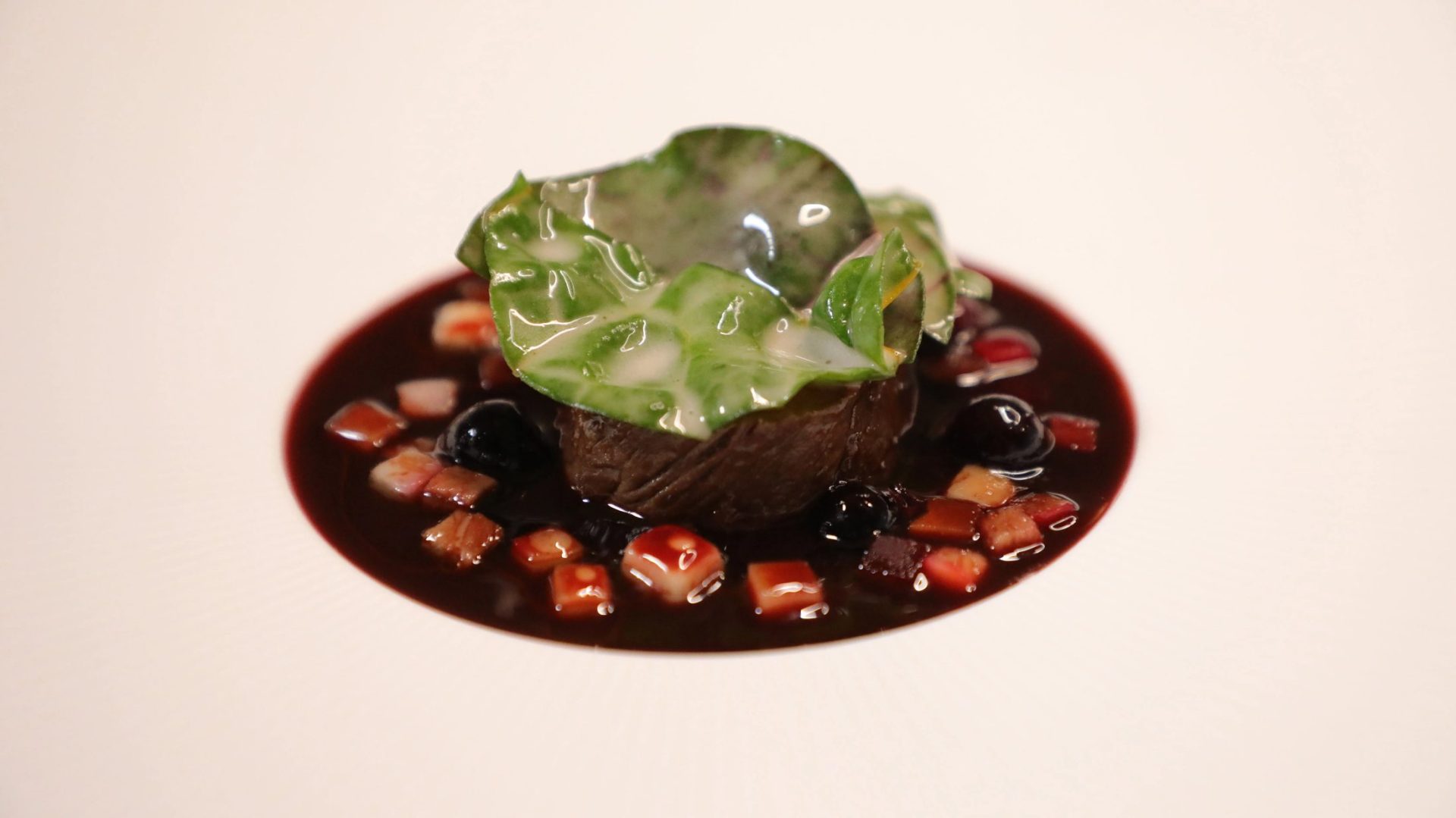

Row on 5, London — tasting menu and canape detail.
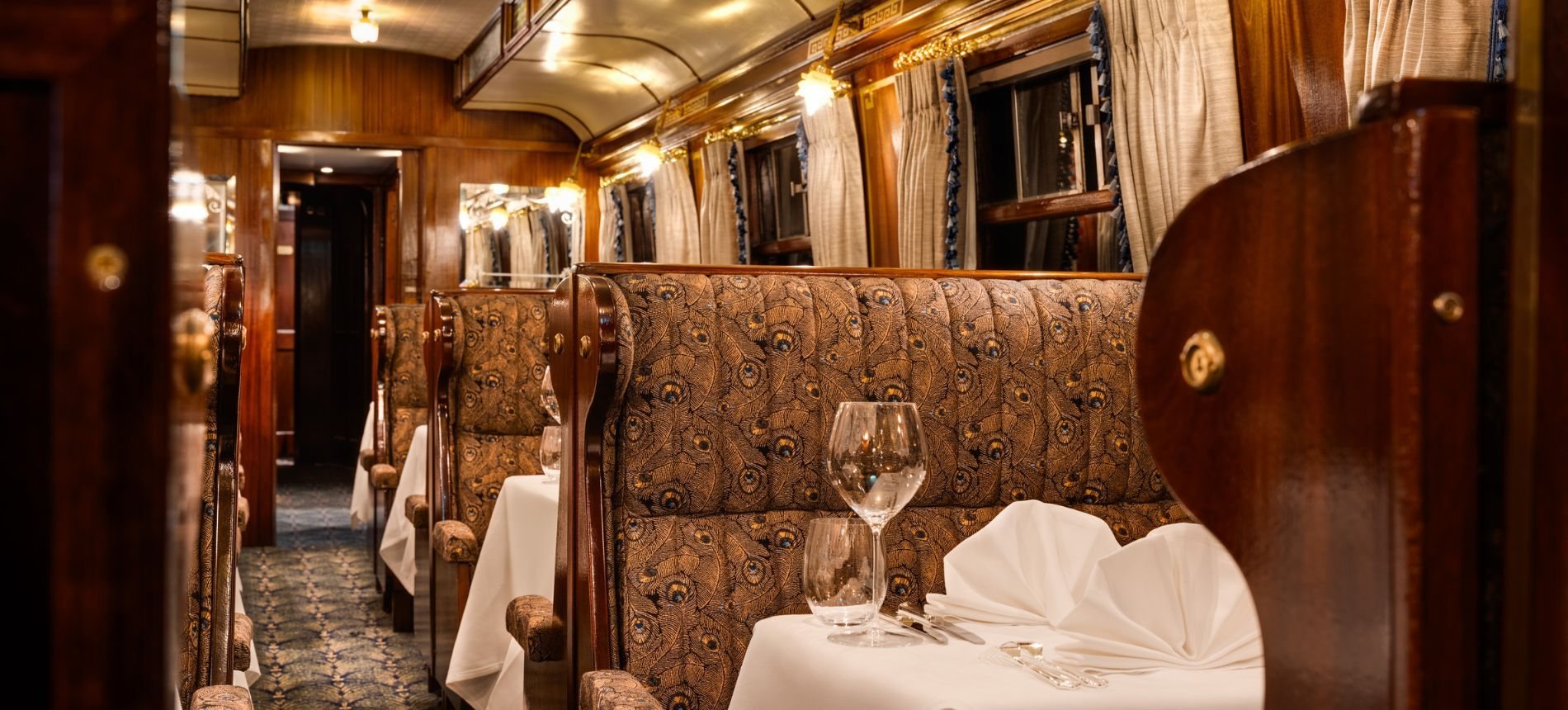
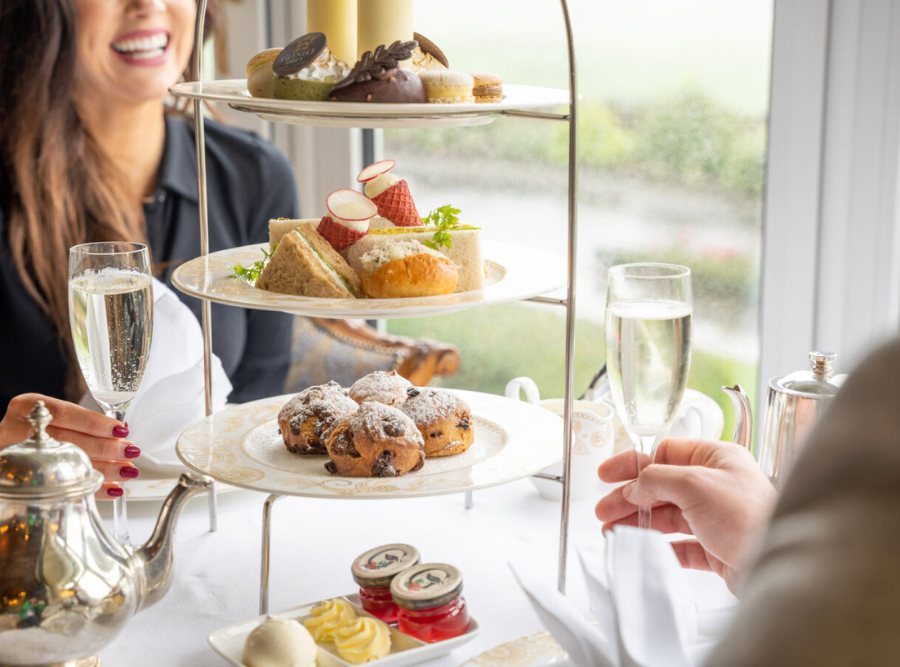
The Pullman, Galway — Orient Express dining car and afternoon tea service.
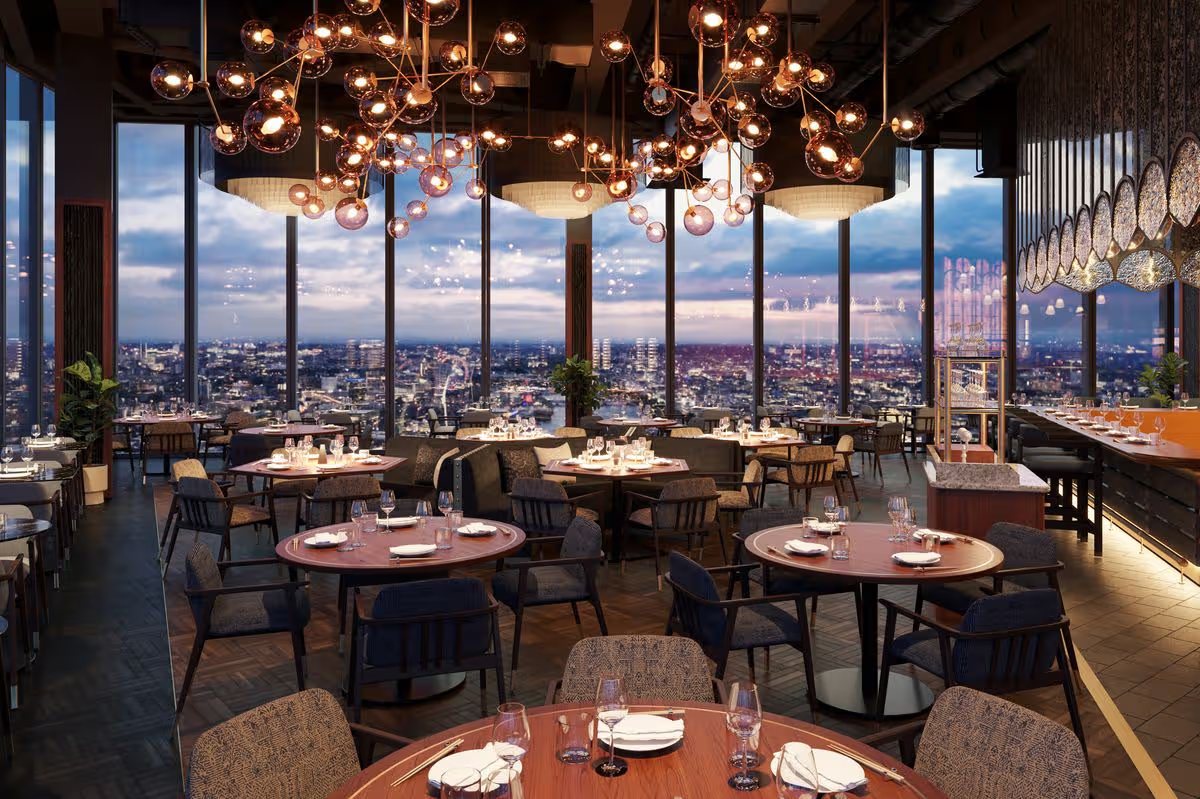
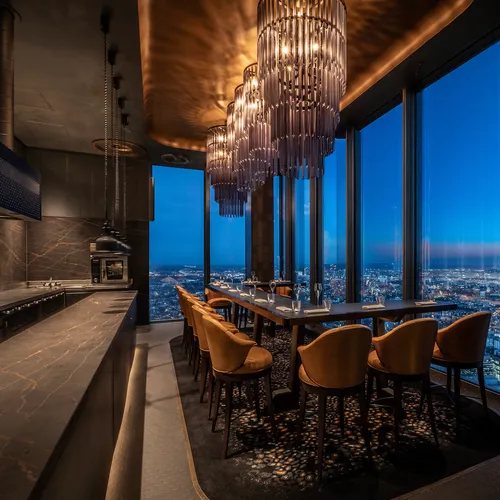
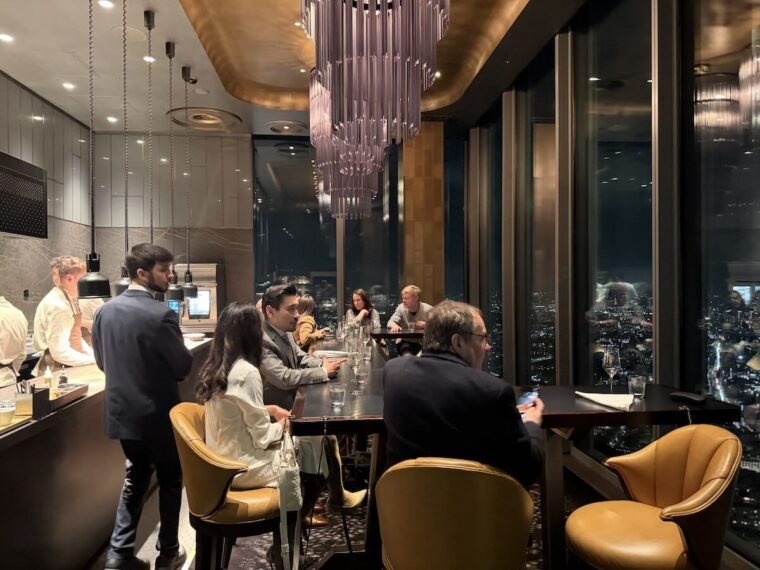
Restaurant Gordon Ramsay High, London — dining room and counter at dusk.
Spatial narrative is not decoration
The phrase “spatial narrative” can sound like design-school language until it is brought back to operations. Space affects arrival, table timing, staff movement, guest conversation, acoustics, lighting, wine service, kitchen visibility and the emotional temperature of the meal. It shapes what the diner believes the restaurant is asking them to value.
In a high-floor restaurant, the room may ask the guest to look outward. In a carriage, it may ask the guest to enter a contained story. In a tasting-menu room, it may ask the guest to trust sequence. In a rural dining room, it may ask the guest to understand land and product. These are not aesthetic choices only. They change the service brief.
The strongest operators start from the question: what does this room help us do that another room could not? If the answer is only “look expensive”, the design will age quickly. If the answer is “slow the guest down”, “stage the evening”, “connect the table to the landscape”, “make the pass visible”, or “give the city back to the diner”, the space begins to earn its role.
This is why Michelin’s 2026 examples are useful for professionals. They remind us that restaurant experience is not held only in recipes. It is held in choreography: the path to the table, the first sightline, the way a chair turns towards a view, the sound of a carriage interior, the distance between chef and guest, the pause before the first pour.
The risk of the extraordinary setting
There is a danger in extraordinary rooms. They can make a restaurant lazy. A dramatic view can become an excuse for ordinary cooking. A heritage space can flatten into costume. A famous architect can turn the dining room into a showroom that the kitchen is forced to serve.
Michelin’s own language around Restaurant Gordon Ramsay High makes the useful distinction. It acknowledges the 60th-floor views but directs attention back to Goodyear’s cooking, produce, balance and precision [Pass2-09]. That is the standard. The setting should heighten the restaurant’s argument, not replace it.
For chefs, the challenge is to cook with the room without surrendering to it. A high-floor restaurant may need clarity rather than visual clutter, because the city is already active in the frame. A carriage restaurant may need pacing that respects intimacy and enclosure. A deeply designed tasting room may need food with enough personality to resist becoming one more object in the composition.
For owners, the financial lesson is equally blunt. An extraordinary setting is expensive to create, maintain or operate. It must earn its rent through bookings, press, event value and guest memory. If the space cannot help the restaurant build repeatable demand, it is theatre without a business case.
What independent restaurants can learn
Independent operators do not need a 60th floor or historic carriage to use spatial narrative. They need attention. A small room can create a stronger sense of occasion by controlling light, table spacing, sound and the moment a guest first sees the pass. A neighbourhood restaurant can make the bar feel like a prelude rather than a waiting area. A chef’s counter can make the relationship between kitchen and guest legible without turning the team into performers.
The lesson is to treat the room as part of menu development. If the restaurant wants to communicate seasonality, where does the room show that? If it wants to communicate craft, what does the guest see by accident? If it wants to feel generous, does the table support sharing, pouring and easy service? If it wants to feel precise, is the pathway of the team calm enough to be believed?
Luxury is not always more design. Often it is fewer contradictions. The food, room, service and price must appear to belong to the same idea. When they do, the restaurant feels inevitable. When they do not, even a spectacular room can feel like rented drama.
The extraordinary canvas is therefore not the point. The point is whether the restaurant knows what to paint on it.
There is also a communications advantage. A restaurant in a remarkable room is easier to photograph, describe and remember. That can help a new opening travel quickly through press, social media and private recommendation. But this is a double-edged benefit. The image may bring the first booking; the restaurant must still create the second. A guest who comes for a carriage or a skyline will only return if the meal has its own authority.
For luxury hotels, this is especially important. The restaurant may become the most visible public room in the property, but the design must support many uses: à la carte service, tasting menus, private events, visiting chefs, regulars, hotel guests and destination diners. A beautiful room that cannot flex becomes expensive theatre. A beautiful room that supports programming becomes a commercial asset.
The best spatial restaurants therefore operate almost like stage sets with discipline. They know where the guest looks, when the team moves, how the room changes at night, and which service moments should be hidden rather than displayed.
For photographers and editors, that means avoiding the usual mistake of showing only the most spectacular angle. A good visual package for this kind of article should include both the room and the human scale inside it: the chef at the pass, the guest’s line of sight, the table spacing, the texture of the materials and the moment service turns architecture into hospitality. The room matters most when people are moving through it.
A room can bring the guest in, but the plate must keep them there.
Why It Matters
This matters because restaurant design now affects more than atmosphere. It influences bookings, service flow, pricing confidence, press value and the guest’s interpretation of the food.
What To Watch Next
Watch whether more Michelin-level openings use height, heritage, landscape or theatrical procession as part of the restaurant proposition, and whether the strongest ones keep the cooking more important than the room.